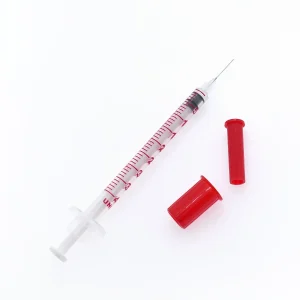
Needlestick injuries remain one of the most persistent occupational hazards in healthcare. Research published in occupational health journals has found that needlestick injury incidence among healthcare workers can run as high as 30–40% over a career, with nurses and interns among the most affected groups, and that roughly half of these injuries could be avoided simply by switching to safety-engineered devices instead of conventional needles. That single statistic explains why hospitals, clinics, and manufacturers have invested heavily in safety syringe technology over the past two decades — and why understanding the different safety syringe types and how each safety syringe mechanism works has become essential knowledge for procurement teams, clinicians, and infection-control officers alike.
This guide breaks down how safety syringes work, the main categories on the market, their comparative advantages, and a practical framework for choosing the right one for your setting.
Why Safety Syringes Matter
Before diving into mechanisms, it’s worth grounding the discussion in data:
- Global estimates suggest more than 35 million healthcare workers face the risk of a percutaneous injury from a contaminated sharp every year.
- Hospitals that introduced safety devices across departments have documented needlestick injury reductions of roughly 20–50%, depending on the procedure type — with the largest drops seen in blood draws and peripheral IV catheter placement.
- Even where safety-engineered devices are available, studies show a meaningful share of injuries still occur because the safety mechanism was not activated correctly — underscoring that device design and staff training must go hand in hand.
- Bloodborne pathogen exposure carries real transmission risk: needlestick exposure to Hepatitis B has historically carried a transmission risk many times higher than HIV exposure from the same type of injury.
These figures are the reason regulatory bodies (including OSHA in the U.S. under the Needlestick Safety and Prevention Act) now require the use of engineered sharps-injury-prevention devices wherever medically feasible.
How a Safety Syringe Mechanism Works
At its core, a safety syringe mechanism is an engineering feature that shields, retracts, or otherwise neutralizes the needle immediately after use, before the user’s hand moves away from the injection site. Mechanisms generally fall into two functional categories:
1. Active (Manual) Mechanisms
The clinician must perform a deliberate action — sliding a shield forward, pressing a plunger to trigger retraction, or clicking a hinged guard into place — to activate the safety feature. Active mechanisms are typically simpler and less expensive to manufacture, but they depend on correct technique, which is why proper training remains critical.
2. Passive (Automatic) Mechanisms
The safety feature activates automatically as part of the normal injection motion, with no extra step required from the user. Passive mechanisms are widely regarded as offering the strongest injury-prevention performance because they remove the possibility of human error or a skipped step under time pressure.
Within these two categories, the specific engineering approaches include:
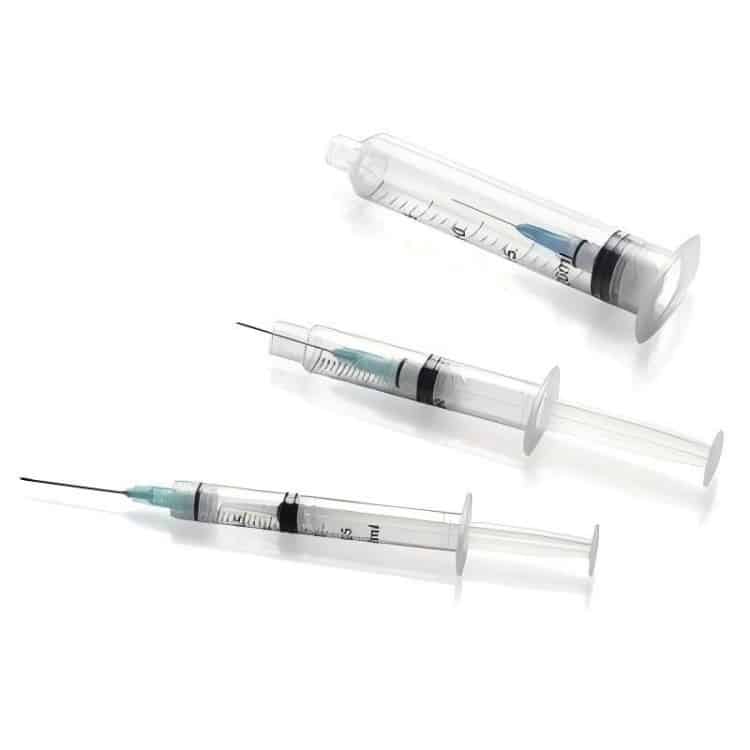
- Spring-loaded retraction — the needle is pulled back into the syringe barrel automatically once the plunger is fully depressed.
- Sliding sheath / shielding sleeve — a plastic sleeve slides forward over the needle after injection and locks in place.
- Hinged needle guard — a small hinged cap swings over the needle tip and clicks into a locked position.
- Retractable barrel systems — the entire needle assembly withdraws into the syringe body, often used in auto-disable designs for single-use-only compliance.
Main Safety Syringe Types
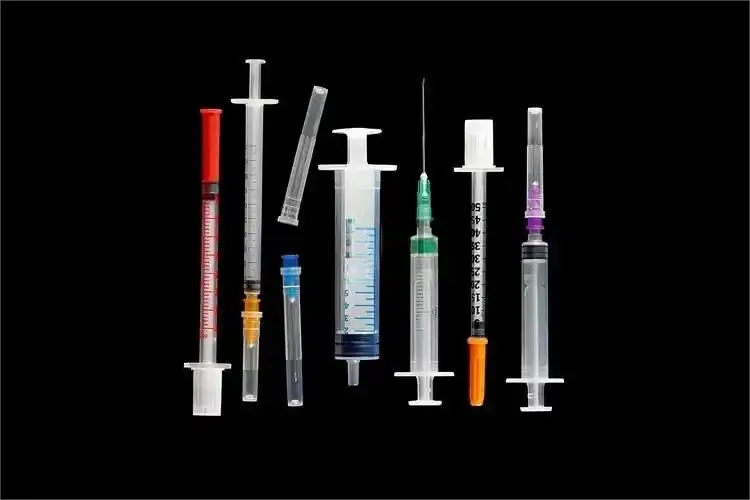
Understanding safety syringe types is really about matching the mechanism to the clinical use case. Below are the categories most commonly used in hospitals, clinics, and home-care settings.
Retractable Safety Syringes
The needle automatically withdraws into the barrel after the injection is complete. These are popular for vaccination programs and mass immunization campaigns because they combine strong injury prevention with straightforward, single-motion use.
Sliding-Sheath (Shielded) Safety Syringes
A protective sleeve extends over the needle and locks after use. This design is common for blood draws, IV medication administration, and general-purpose injections, since the visible “click-lock” gives clinicians immediate tactile and visual confirmation that the sharp is secured.
Hinged-Cap Safety Syringes
A small hinged shield is folded over the needle tip by hand and locked into place. These tend to be lower-cost and are frequently used in outpatient clinics, blood donation centers, and settings with high injection volume where cost per unit matters.
Auto-Disable (AD) Syringes
Designed primarily for immunization programs recommended by the WHO, auto-disable syringes lock permanently after a single use, preventing reuse — an important feature in regions where syringe reuse has historically driven disease transmission.
Pen-Needle Safety Devices
Used with insulin pens and other self-injection devices, these incorporate spring-loaded or shielded needle covers designed for patient self-administration, where ease of use and low anxiety matter as much as injury prevention.
If you’re comparing these categories side by side for procurement or clinical evaluation, it can help to review a full <a href=”https://kohope.com/syringes/”>range of safety syringe types</a> to see how mechanism, needle gauge, and application map onto real product specifications.
Key Benefits of Safety Syringes
- Reduced occupational exposure risk — the primary driver behind adoption, directly lowering the incidence of bloodborne pathogen transmission among staff.
- Regulatory compliance — many jurisdictions now mandate engineered sharps-injury-prevention devices for eligible procedures.
- Improved staff confidence and morale — surveys of healthcare workers after safety-device rollout have shown high satisfaction rates, with the large majority reporting they felt safer using the new devices.
- Lower downstream costs — post-exposure prophylaxis, lab testing, lost work time, and litigation associated with needlestick injuries are far more expensive than the incremental cost of safety-engineered devices.
- Patient trust — visible safety mechanisms, especially in outpatient and pediatric settings, can reduce patient anxiety around injections.
Safety Syringe Selection Guide
Choosing the right device isn’t one-size-fits-all. Consider these factors:
- Mechanism type (active vs. passive) — Passive mechanisms generally offer higher, more consistent injury-prevention rates and are preferable in high-volume or high-turnover staffing environments.
- Clinical application — Vaccination programs often favor auto-disable or retractable designs; blood draws and infusion therapy often favor sliding-sheath designs; self-administration favors pen-needle safety systems.
- Needle gauge and syringe volume — Match the gauge (commonly 21G–30G) and barrel size (0.5 mL to 10 mL+) to the medication and patient population, from neonatal to adult dosing.
- Activation feedback — Look for an audible or tactile “click” confirming the mechanism has locked, which reduces the risk of incomplete activation.
- Regulatory and compliance requirements — Confirm the device meets applicable standards (e.g., ISO 23908 for sharps-injury protection) and any regional mandates for your facility type.
- Ease of training — Devices that require minimal behavior change from standard technique tend to see faster, more consistent adoption among staff.
- Cost per unit vs. total cost of ownership — Factor in reduced injury-related costs, not just unit price, when comparing options across large-volume procurement.
Conclusion
Safety syringes have become a standard of care rather than an optional upgrade, and for good reason: the data consistently shows that engineered sharps-injury-prevention devices meaningfully reduce needlestick injuries and the serious infection risks that come with them. Understanding the different safety syringe types — retractable, sliding-sheath, hinged-cap, auto-disable, and pen-needle systems — along with the active versus passive safety syringe mechanism behind each one, gives clinical teams and procurement managers the foundation they need to select devices that protect both staff and patients while fitting the realities of their clinical setting and budget.