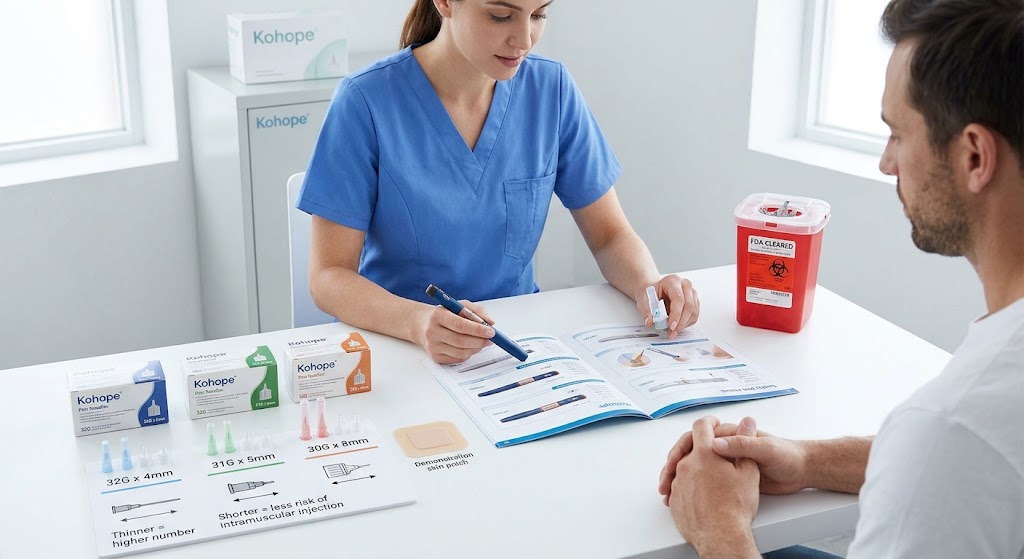
For millions of people living with diabetes, the insulin pen is part of daily life. Yet the small piece of hardware that actually touches the skin, the pen needle, rarely gets the attention it deserves. Careful insulin pen needle selection can make injections more comfortable, improve insulin absorption, and reduce the risk of injury for both patients and caregivers. At Kohope, we manufacture pen needles and safety pen needle systems every day, and we see how much a well-chosen needle changes the injection experience.
This guide uses a simple 5W+1H framework (What, Why, Who, When, Where, and How) to walk you through insulin pen needle selection, explain how to compare each insulin pen needle size, and show how to use a safety pen needle correctly from the first injection to final disposal.
What Is an Insulin Pen Needle, and What Is a Safety Pen Needle?
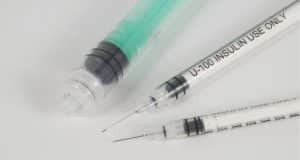
An insulin pen needle is a single-use, sterile, hollow needle that attaches to a reusable or prefilled insulin pen. It delivers insulin into the fatty layer just under the skin, known as subcutaneous tissue. Most pen needles consist of a thin stainless steel cannula, a plastic hub that screws or snaps onto the pen, an outer cap, and an inner shield.
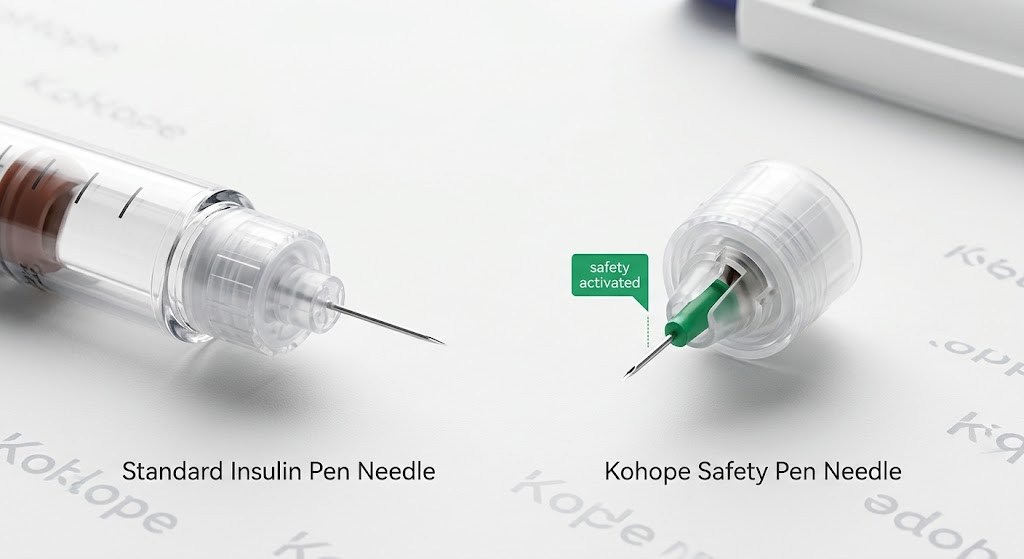
A safety pen needle adds a protective mechanism designed to prevent accidental needlestick injuries after the injection. Depending on the design, the mechanism may be:
- A retractable shield that slides over the needle once the injection is complete.
- A passive lock-out system that engages automatically when the needle is withdrawn from the skin.
- An active safety system that requires the user to press or slide a component to cover the needle.
A standard pen needle leaves the used needle exposed unless the user carefully removes it. A safety pen needle shields the sharp immediately, which matters most in clinics, hospitals, long-term care facilities, and homes where a caregiver administers insulin.
Insulin pen needle selection therefore involves three questions: which needle size suits the person, whether a safety pen needle is appropriate for the setting, and whether the needle is compatible with the insulin pen being used.
Why Does Insulin Pen Needle Selection Matter?
Many people treat pen needles as interchangeable accessories. In practice, careful insulin pen needle selection affects five things:
1. Comfort and pain
Needle diameter (gauge) and length influence how much an injection hurts. Thinner, shorter needles are generally associated with less discomfort, which can help people stay consistent with their insulin routine.
2. Insulin delivery and glucose control
Insulin is meant to be absorbed from subcutaneous fat. If the needle is too long for the person’s body and technique, insulin may reach muscle, where absorption is faster and less predictable, which can contribute to glucose variability and hypoglycemia. If the needle is too short or the technique is poor, insulin may leak or be deposited too shallowly.
3. Skin and tissue health
Reusing needles or choosing an unsuitable insulin pen needle size can contribute to bruising, bleeding, and lipohypertrophy, the lumpy fatty deposits that form when injection sites are overused. Insulin injected into lipohypertrophic tissue is absorbed erratically.
4. Safety for patients and caregivers
Needlestick injuries expose healthcare workers and caregivers to bloodborne pathogens. A safety pen needle is a practical way to reduce that risk.
5. Adherence
People who fear needles or find injections painful may skip doses. A comfortable needle that is easy to use supports adherence, one of the most important factors in long-term diabetes management.
Who Needs to Think About Insulin Pen Needle Selection?
People with diabetes who inject insulin
Anyone using an insulin pen, whether they have type 1, type 2, or gestational diabetes, benefits from a considered insulin pen needle selection. The best choice can differ by body type, injection site, insulin dose, and personal comfort.
Children and teens
Young people often have less subcutaneous fat, and injection technique matters more. Shorter needles are commonly used in pediatric care, and the right insulin pen needle size is typically chosen with a diabetes care team.
Older adults
Older adults may have thinner skin, reduced dexterity, or vision challenges. A needle that is easy to attach and a safety pen needle that is simple to operate can make a real difference.
Caregivers and family members
Parents, spouses, and home health aides who inject insulin for someone else face a genuine needlestick risk. A safety pen needle is a strong option for them.
Nurses, hospitals, and clinics
Healthcare facilities in the United States operate under bloodborne pathogen rules that call for safer needle devices where feasible, so a safety pen needle is often the standard in clinical settings. Procurement teams comparing options for insulin pen needle selection should weigh needle performance, safety activation, and compatibility with the pens they stock.
When Should You Reassess Your Pen Needle Choice?
Insulin pen needle selection isn’t a one-time decision. Consider reviewing your choice when:
- You start insulin or switch to a new insulin pen.
- Your weight changes significantly, which changes the thickness of subcutaneous tissue.
- You notice problems, such as frequent bleeding, bruising, pain, or insulin leaking from the injection site.
- Your glucose readings are unexplained, with unexpected highs or lows that may relate to injection technique.
- You discover lumps at injection sites.
- A caregiver takes over injections, which may make a safety pen needle the better option.
- Your facility updates its safety protocols or purchasing standards.
A short conversation with a healthcare professional or certified diabetes care and education specialist at these moments can prevent months of avoidable problems.
Where Does the Needle Go? Injection Sites and Needle Choice
Common insulin injection sites include the abdomen, the front and outer thigh, the back of the upper arm, and the upper buttock. The abdomen generally offers the most consistent and rapid absorption, while thighs and buttocks absorb more slowly. The upper arm can be harder to reach safely on your own.
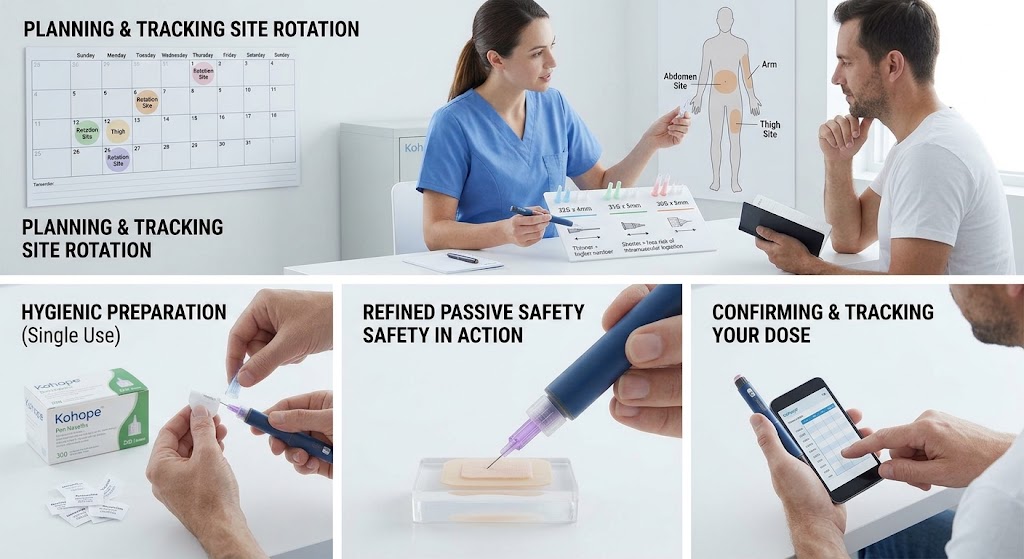
Site matters for insulin pen needle selection because the amount of subcutaneous fat varies across the body. Arms and thighs often have a thinner fat layer than the abdomen, so a shorter needle and careful technique are especially important there. Rotating sites within and between body areas helps prevent lipohypertrophy, and your care team can help you build a rotation plan that fits your insulin type.
How to Choose: Insulin Pen Needle Size Explained
This is the heart of insulin pen needle selection. Every insulin pen needle size is defined by two numbers: gauge and length.
Understanding gauge
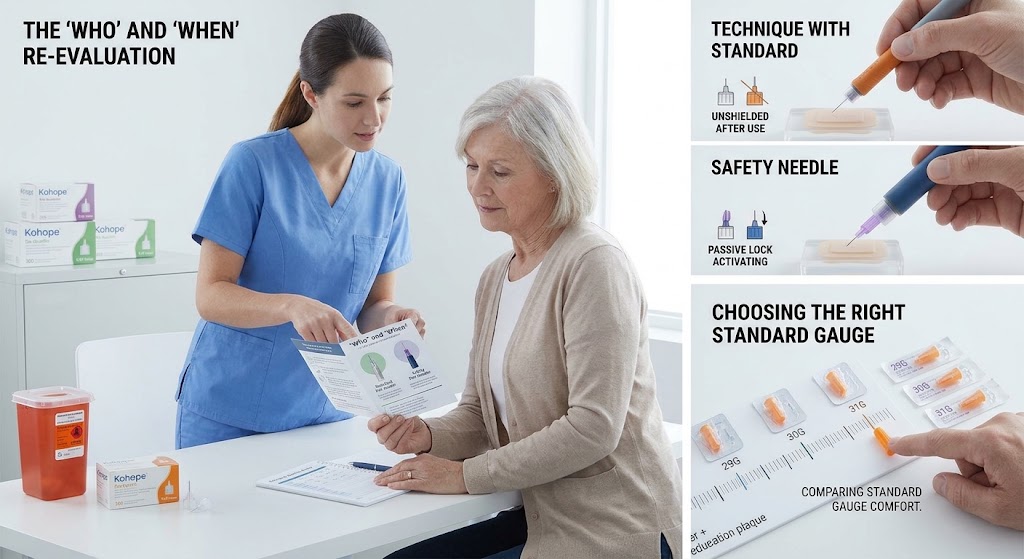
Gauge describes the needle’s outer diameter. The counterintuitive rule is that a higher gauge number means a thinner needle. Common pen needle gauges range from about 29G to 34G.
| Gauge | Relative thickness | Typical notes |
|---|---|---|
| 29G | Thicker | Older standard, less common now |
| 31G | Medium-thin | Widely used |
| 32G | Thin | Common choice for comfort |
| 33G | Very thin | Popular for sensitive users |
| 34G | Thinnest | Offers an ultra-fine option |
Thinner needles tend to feel more comfortable, but very thin needles can require slightly more thumb pressure or a slower injection for thick insulin formulations. Good manufacturing quality matters here: a precisely ground tip and a consistent wall design help a fine-gauge needle glide through skin smoothly.
Understanding length
Pen needle length is measured in millimeters. Typical options include 4 mm, 5 mm, 6 mm, 8 mm, 10 mm, and 12 mm.
- 4 mm: The shortest commonly available option. International injection technique recommendations have supported 4 mm pen needles as safe and effective for adults and children, including people with obesity, and they carry a lower risk of intramuscular injection.
- 5 mm and 6 mm: Widely used and suitable for many people. Depending on the person and injection site, a skin fold may be recommended with these lengths.
- 8 mm and longer: Longer needles were once standard, but they are now generally less preferred because of the higher risk of reaching muscle, particularly in lean individuals and children.
Because individual circumstances differ, the right insulin pen needle size should be confirmed with your healthcare team. As a general principle, many experts today favor shorter needles because they deliver insulin reliably into subcutaneous tissue with less risk and often less discomfort.
Do you need a skin fold (pinch-up)?
With 4 mm needles, most people can inject at a 90-degree angle without lifting a skin fold. With 5 mm and 6 mm needles, a skin fold may be advised for people with very little body fat or for certain sites such as the limbs. Your care team can show you the proper technique.
Compatibility with your pen
Most major insulin pens accept standard pen needle connections, but always check the packaging and the pen manufacturer’s instructions. A needle that doesn’t seat securely can leak or fail to prime properly. When evaluating insulin pen needle selection for a clinic or hospital, confirm compatibility across all pen brands in use.
Quick checklist for insulin pen needle selection
- Confirm compatibility with your insulin pen.
- Choose a comfortable gauge, commonly 31G to 34G.
- Choose an appropriate length, often 4 mm to 6 mm, with guidance from your healthcare team.
- Decide whether a safety pen needle is needed, based on who is giving the injection and where.
- Check quality and sterility: intact packaging, clear labeling, and a reputable manufacturer.
- Re-evaluate periodically as your body, insulin regimen, or care setting changes.
How Does a Safety Pen Needle Work?
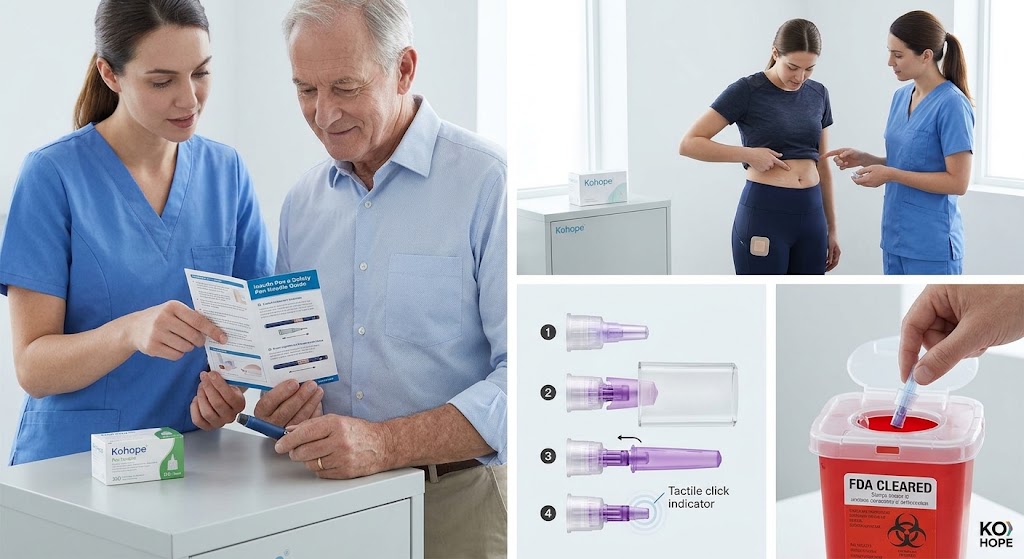
A safety pen needle is built around one idea: stop the needle from injuring anyone after the insulin has been delivered. Here’s how the process typically works with a shielded design:
- The safety pen needle is attached to the pen, and the outer cap is removed.
- The injection is performed as usual, with the needle pressed against the skin.
- As the needle is withdrawn, or when the user activates the mechanism, a shield extends or slides over the needle and locks.
- The covered needle is removed from the pen and placed in a sharps container.
Because the sharp is covered before the user handles the device again, the opportunity for accidental contact is greatly reduced. Good safety pen needle design also keeps the injection feeling normal: the user shouldn’t have to fight the mechanism or apply unusual force.
Why a safety pen needle is valuable in healthcare settings
In the United States, the Needlestick Safety and Prevention Act and related OSHA bloodborne pathogen requirements push employers in healthcare settings to evaluate and use safer sharps devices where appropriate. For hospitals, clinics, and long-term care facilities, selecting a reliable safety pen needle supports staff protection and compliance. Home caregivers aren’t bound by workplace rules, but they face the same biological risks, so a safety pen needle can be just as relevant at home.
What to look for in a safety pen needle
- Simple activation, ideally passive or one-handed.
- Clear confirmation that the shield has locked, whether visual, audible, or both.
- Consistent injection performance, with a needle that is just as sharp and smooth as a standard pen needle.
- Compatibility with common insulin pens.
- Clean, intuitive packaging that supports fast, error-free handling.
- Manufacturer quality systems that support consistent production and traceability.
How to Use an Insulin Pen Needle Correctly: Step by Step
Even the best insulin pen needle selection can be undermined by poor technique. The following steps outline good practice. Always follow the instructions that come with your pen and your healthcare provider’s guidance.
Step 1: Prepare
Wash your hands. Check the insulin label, type, and expiration date. If your insulin is cloudy, mix it as directed by the manufacturer.
Step 2: Attach a new needle
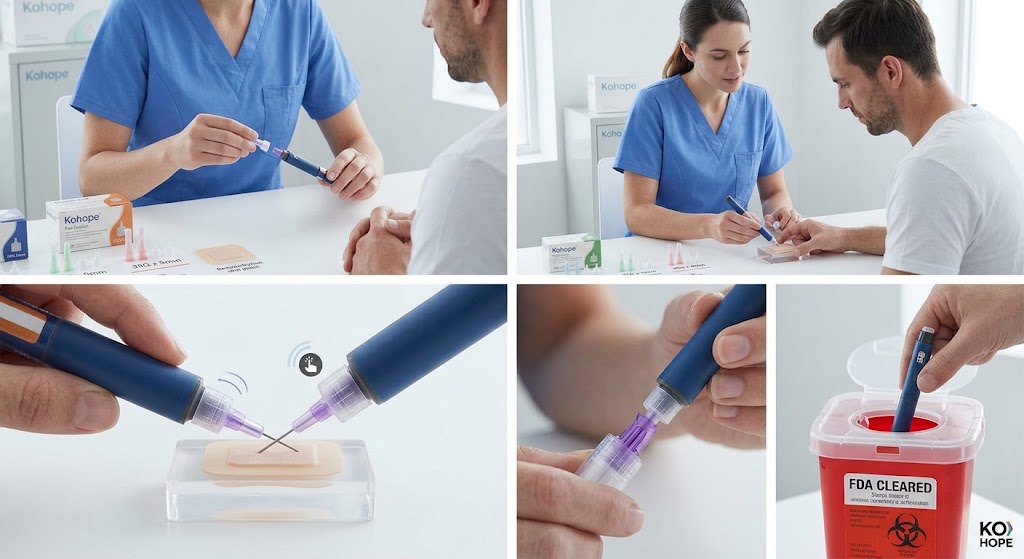
Remove the paper seal from a fresh pen needle, then screw or push it straight onto the pen. Remove the outer cap and keep it handy, and remove the inner shield if your design has one. If you use a safety pen needle, follow the specific instructions for that product, as mechanisms differ.
Step 3: Prime the pen
Dial a small test dose, often 2 units, and press the plunger with the needle pointing upward. Insulin should appear at the needle tip. Priming removes air and confirms the needle isn’t blocked. If no insulin appears, repeat according to your pen’s instructions.
Step 4: Dial your dose
Set the prescribed dose and confirm it in the dose window.
Step 5: Choose and clean the site
Pick a site you haven’t used recently and inspect the skin for lumps, redness, or scars. Avoid injecting into lipohypertrophic areas. The skin should be clean and dry.
Step 6: Inject
Insert the needle straight into the skin at a 90-degree angle, with or without a skin fold depending on your insulin pen needle size and your care team’s advice. Press the button slowly and steadily until the dose counter returns to zero.
Step 7: Hold and withdraw
Keep the needle in place for the time your pen’s instructions recommend, commonly about 10 seconds, so the full dose can be delivered and insulin doesn’t leak back out. Then withdraw the needle. If you are using a safety pen needle, make sure the safety shield has activated.
Step 8: Remove and dispose
Remove the used needle from the pen without recapping it by hand (unless your device design instructs otherwise), and place it directly into a sharps container.
Step 9: Rotate sites
Record or mentally track where you injected so that the next injection goes to a fresh area.
Common Mistakes to Avoid
Reusing pen needles. Needles are designed for single use. Reuse can dull the tip, increase pain, raise the risk of tissue damage and lipohypertrophy, and may allow contamination or clogging.
Leaving the needle on the pen. This can allow air to enter the cartridge or insulin to leak, which may affect dose accuracy.
Skipping the priming step. A blocked or air-filled needle can lead to under-dosing.
Choosing a needle that is too long. Excess length increases the chance of intramuscular injection.
Injecting repeatedly in the same spot. This promotes lipohypertrophy and uneven absorption.
Ignoring sharps safety. Never throw loose needles into household trash or recycling.
Safe Disposal of Pen Needles
Proper disposal protects family members, sanitation workers, and the community. In the United States, the FDA recommends using an FDA-cleared sharps disposal container when possible. If one isn’t available, a heavy-duty plastic household container with a tight-fitting, puncture-resistant lid, such as a laundry detergent bottle, can be a temporary alternative. Label it clearly, keep it away from children and pets, and never fill it beyond about three-quarters full. Disposal rules vary by state and community, so check local guidance or ask your pharmacy about mail-back or drop-off programs.
A safety pen needle reduces the risk of an injury during handling, but it doesn’t remove the need for a sharps container. The used device still goes into a proper sharps container.
Standard Pen Needle vs. Safety Pen Needle: Which One Is Right for You?
| Factor | Standard pen needle | Safety pen needle |
|---|---|---|
| Typical user | Individuals self-injecting at home | Healthcare staff, caregivers, institutions |
| Needle protection after use | None built in | Built-in shield or lock-out |
| Needlestick risk | Higher if mishandled | Significantly reduced |
| Ease of use | Familiar and simple | Simple once the mechanism is learned |
| Cost | Generally lower | Generally higher per unit |
| Regulatory alignment in clinical settings | May not meet safer-device goals | Supports safer-sharps compliance |
If you inject yourself at home and have a sound technique, a standard pen needle with careful disposal may be perfectly appropriate. If someone else gives your injections, or if you work in a healthcare setting, a safety pen needle is usually the better fit. Your clinician or facility safety officer can help you make the final call.
What Does a Pen Needle Manufacturer Look For? The Kohope Perspective
As a manufacturer specializing in injection supplies, Kohope approaches pen needle design with a few guiding principles that also help buyers evaluate any product.
Sharpness and consistency. The tip geometry determines how easily the needle enters the skin. Precision grinding and consistent processes help reduce penetration force and discomfort, which is especially important for fine gauges such as 32G, 33G, and 34G.
Reliable connection. A pen needle must fit securely and align properly with the pen cartridge to avoid leakage and ensure accurate dosing. Tight tolerances and thorough testing support dependable performance.
Safety by design. Our approach to safety pen needle development focuses on mechanisms that are intuitive and dependable, so protection is built into the natural rhythm of the injection rather than added as an extra step.
Sterility and packaging. Each needle should arrive sterile, with tamper-evident, easy-to-open packaging and clear labeling of gauge and length, which makes insulin pen needle selection easier for users and procurement teams alike.
Range of options. People and clinics have different needs, so a manufacturer should offer a thoughtful range of gauges and lengths, including options for sensitive users and for institutional use.
Quality systems. Behind every needle is a quality management process covering materials, production, inspection, and traceability. When assessing suppliers, buyers should ask about their manufacturing standards and documentation.
These are the same questions we encourage every healthcare buyer, distributor, and patient to ask when comparing products. A well-informed approach to insulin pen needle selection protects the people who depend on these small devices every day.
Frequently Asked Questions
What is the best insulin pen needle size?
There is no single best insulin pen needle size for everyone. Many people do well with a thin gauge (31G to 34G) and a short length (4 mm to 6 mm), but the right choice depends on body type, injection site, and your care team’s advice.
Is a shorter needle less effective?
No. Research and international technique recommendations support short pen needles for reliable subcutaneous delivery, and they reduce the chance of intramuscular injection.
Can I reuse a pen needle to save money?
Reusing needles is not recommended. A used needle can become dull or bent, increasing pain and tissue trauma, and it may lead to clogging or contamination.
Who should use a safety pen needle?
A safety pen needle is especially valuable for nurses, home health aides, family caregivers, and anyone in a facility where staff must follow safer-sharps practices. Individuals who self-inject may also choose one for added peace of mind.
Will a safety pen needle change how the injection feels?
A well-designed safety pen needle should feel very similar to a standard needle. The main difference is the protective shield that covers the needle after use.
How often should I review my insulin pen needle selection?
Review it whenever your weight, insulin regimen, injection sites, or care setting changes, and at routine visits with your diabetes care team.
Are all pen needles compatible with all insulin pens?
Most are designed to fit widely used pens, but always verify compatibility on the packaging and in your pen’s instructions before purchase.
Key Takeaways
- Thoughtful insulin pen needle selection improves comfort, absorption, safety, and adherence.
- Every insulin pen needle size is defined by gauge and length. Thinner and shorter needles are widely favored today, but your care team should confirm the best fit.
- A safety pen needle protects patients, caregivers, and healthcare workers from accidental needlesticks and supports safer-sharps practices.
- Good technique (priming, correct angle, a full hold time, site rotation, and single use) matters as much as the needle itself.
- Always dispose of used needles in a proper sharps container.
- Choose a manufacturer that prioritizes sharpness, secure fit, sterility, and dependable safety design.
Conclusion
The pen needle may be the smallest part of insulin therapy, but it shapes every injection. By understanding gauge and length, matching the insulin pen needle size to the person and the site, and choosing a safety pen needle when the setting calls for it, you can make insulin delivery safer, more comfortable, and more consistent. Good insulin pen needle selection is an investment in daily confidence for patients, caregivers, and clinicians alike.
If you’re evaluating options for your clinic, pharmacy, or distribution network, the Kohope team is ready to discuss our range of pen needles and safety pen needle solutions.
This article is for educational purposes only and does not replace advice from a qualified healthcare professional. Consult your doctor or diabetes care and education specialist before changing your needle type, injection technique, or insulin regimen.