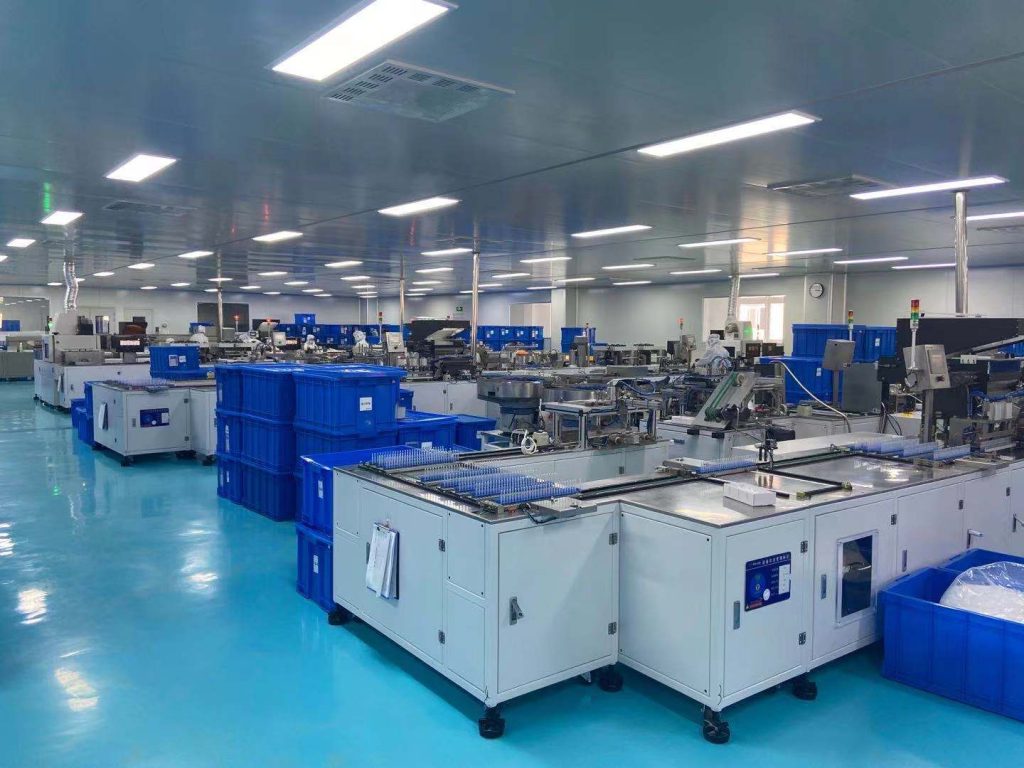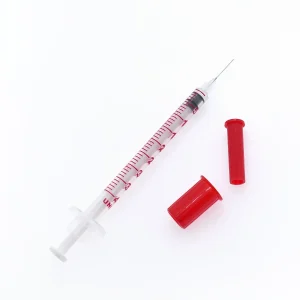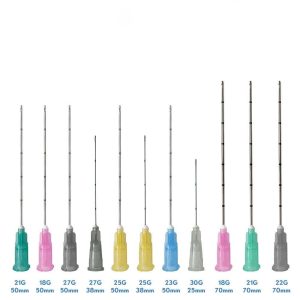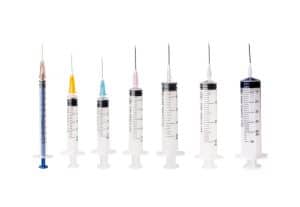
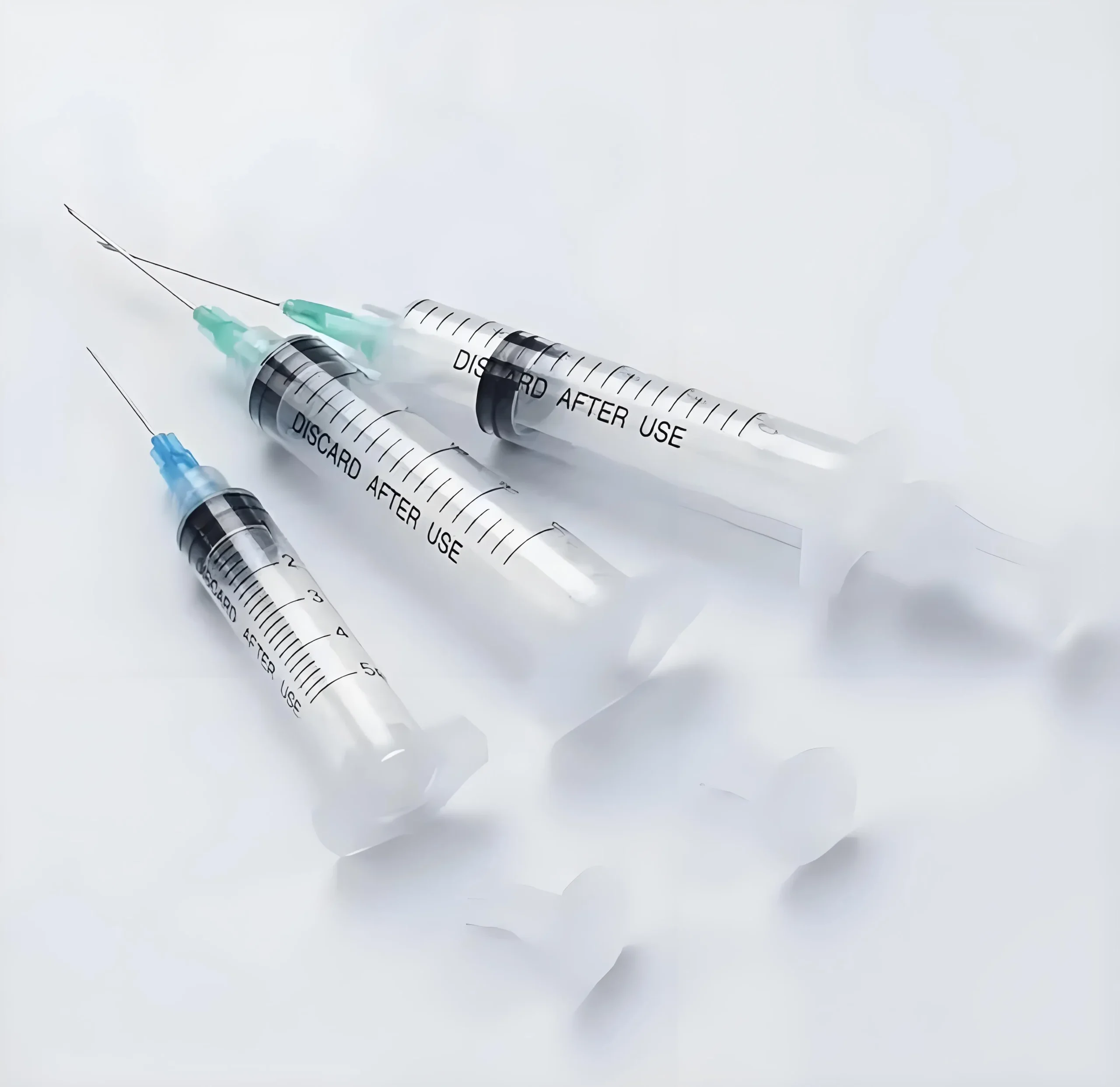
When it comes to specialized medical applications, off-the-shelf solutions don’t always cut it. Whether you’re developing a novel drug delivery system, creating a veterinary-specific treatment protocol, or manufacturing diagnostic equipment, custom printed syringes, custom made syringes, and custom hypodermic tubing have become essential tools for procurement professionals seeking competitive advantages.
Why the Custom Syringe Market Is Exploding
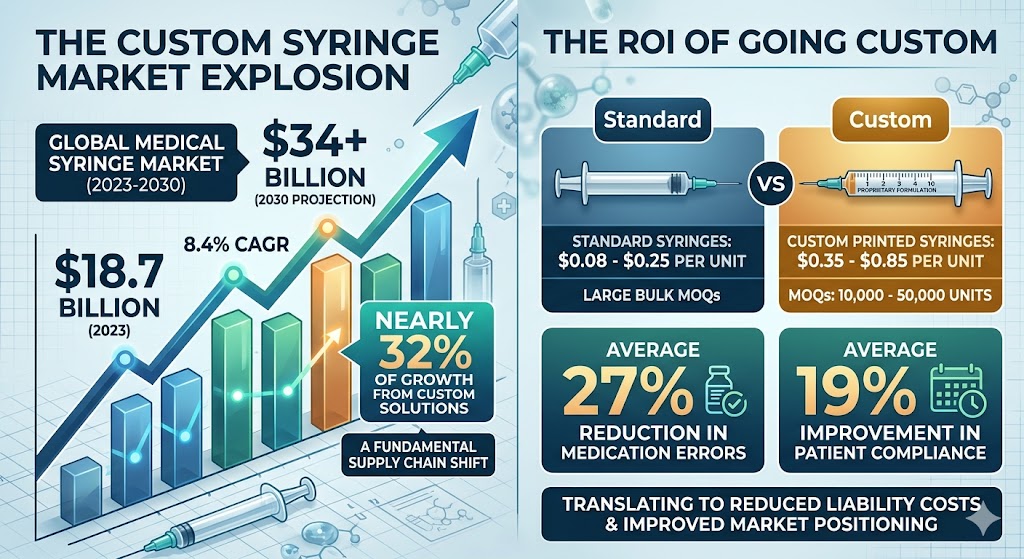
The global medical syringe market reached $18.7 billion in 2023 and is projected to grow at a CAGR of 8.4% through 2030. But here’s what most people miss: nearly 32% of that growth is coming from customized solutions rather than standard products. This shift reflects a fundamental change in how medical device companies, pharmaceutical manufacturers, and research institutions approach their supply chains.
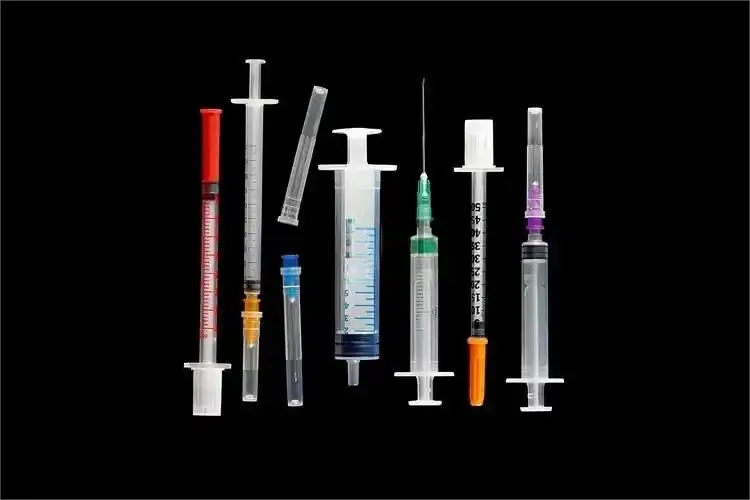
The Real Cost of Going Custom
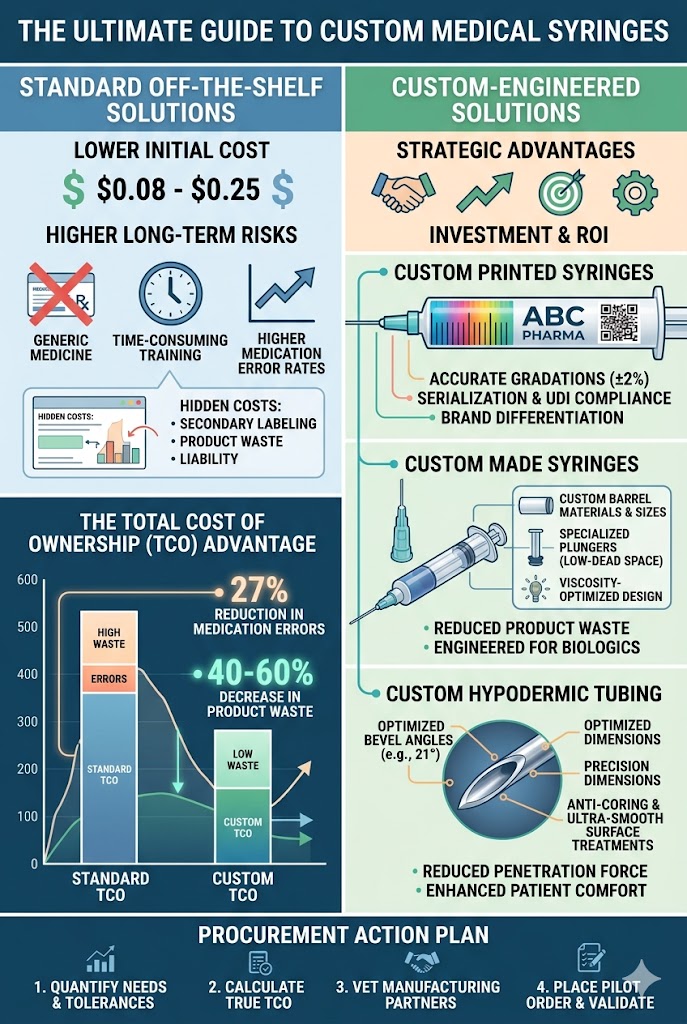
Let’s talk numbers. Standard syringes typically cost between $0.08 to $0.25 per unit when ordered in bulk. Custom made syringes start at approximately $0.35-$0.85 per unit, with minimum order quantities (MOQs) ranging from 10,000 to 50,000 units depending on the manufacturer and complexity level.
However, here’s the procurement insight that changes everything: companies using custom printed syringes for their proprietary formulations report an average 27% reduction in medication errors and a 19% improvement in patient compliance—metrics that translate directly to reduced liability costs and improved market positioning.
Understanding Your Custom Syringe Options
1. Custom Printed Syringes: Branding Meets Function
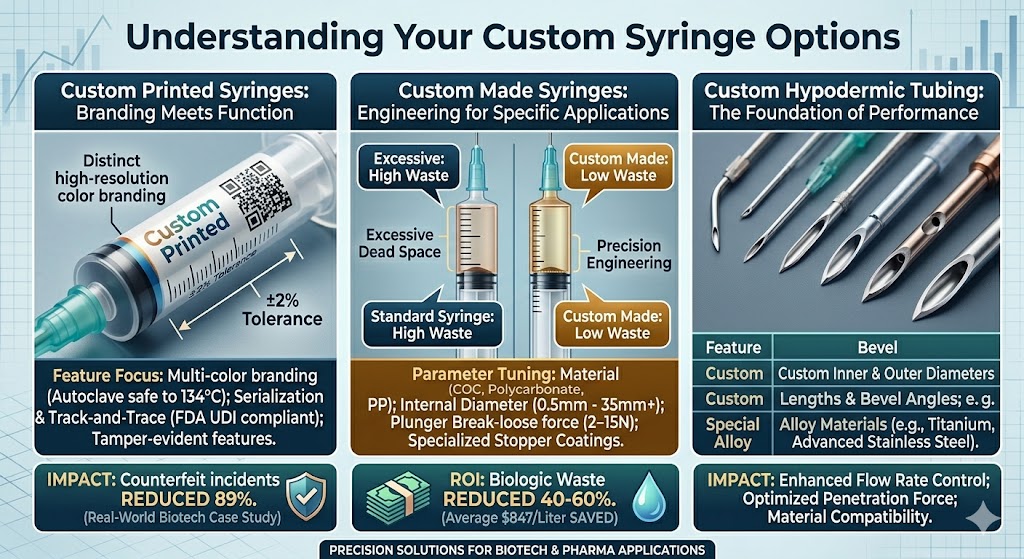
Custom printed syringes go far beyond simple aesthetics. Modern printing technologies allow for:
- High-resolution gradation marks with accuracy tolerances of ±2%
- Multi-color branding elements that survive autoclave sterilization (up to 134°C)
- Serialization and track-and-trace capabilities compliant with FDA UDI requirements
- Tamper-evident features integrated directly into the barrel design
Real-world application: A mid-sized biotech company we analyzed reduced counterfeit incidents by 89% after switching to custom printed syringes with proprietary color schemes and serialization. Their procurement cost increased by just 14%, but warranty claims dropped by over $2.3 million annually.
2. Custom Made Syringes: Engineering for Specific Applications
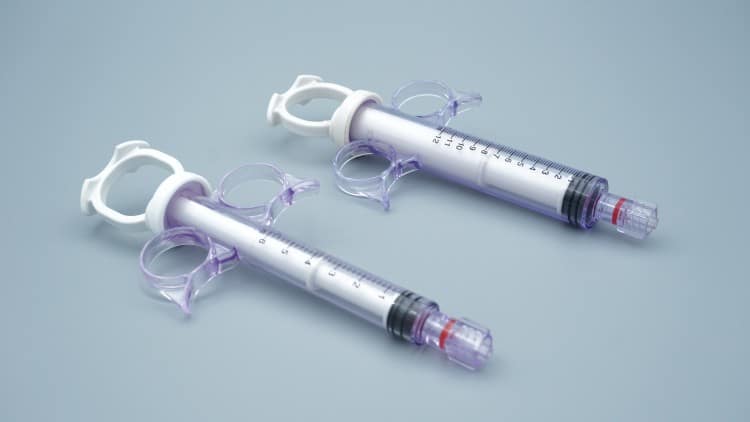
When standard barrel sizes, plunger mechanisms, or tip configurations don’t match your application, custom made syringes become necessary. Key customization parameters include:
Barrel specifications:
- Internal diameter variations (0.5mm to 35mm+)
- Length modifications (10mm to 200mm+)
- Material selection (polypropylene, polycarbonate, cyclic olefin copolymer)
- Transparency levels and UV-blocking properties
Plunger design:
- Rubber composition (natural, synthetic, silicone-free options)
- Break-loose and glide forces (typically 2-15 Newtons)
- Dead space reduction (critical for expensive biologics)
- Stopper coating options for viscous medications
Industry data point: Pharmaceutical companies manufacturing pre-filled syringes with biologics waste an average of $847 per liter of drug product due to dead space in standard syringes. Custom made syringes with optimized dead space can reduce this waste by 40-60%, creating immediate ROI for high-value medications.
3. Custom Hypodermic Tubing: The Foundation of Performance
Most procurement professionals don’t realize that custom hypodermic tubing represents the most technically complex customization option—and often the most impactful. Standard gauge sizes follow the Birmingham Wire Gauge system, but custom solutions allow for:
Dimensional customization:
- Wall thickness variations (as thin as 0.05mm for minimally invasive procedures)
- Non-standard outer diameters for specialized equipment compatibility
- Length precision within ±0.1mm tolerances
- Custom bevel angles (12°, 18°, 21°, or proprietary designs)
Surface treatments:
- Silicone coating for reduced friction (50-80% glide force reduction)
- Hydrophilic coatings for aqueous solutions
- Anti-coring treatments for rubber stopper penetration
- Electropolishing for ultra-smooth internal surfaces
Material options:
- Stainless steel grades (304, 316L, 420)
- Titanium alloys for MRI compatibility
- Nickel-free compositions for allergy concerns
Procurement insight: A veterinary device manufacturer switched to custom hypodermic tubing with a specialized bevel angle and coating. Their needle penetration force dropped by 43%, leading to a 34% increase in veterinarian satisfaction scores and securing contracts with three major animal health distributors.
The Procurement Decision Framework
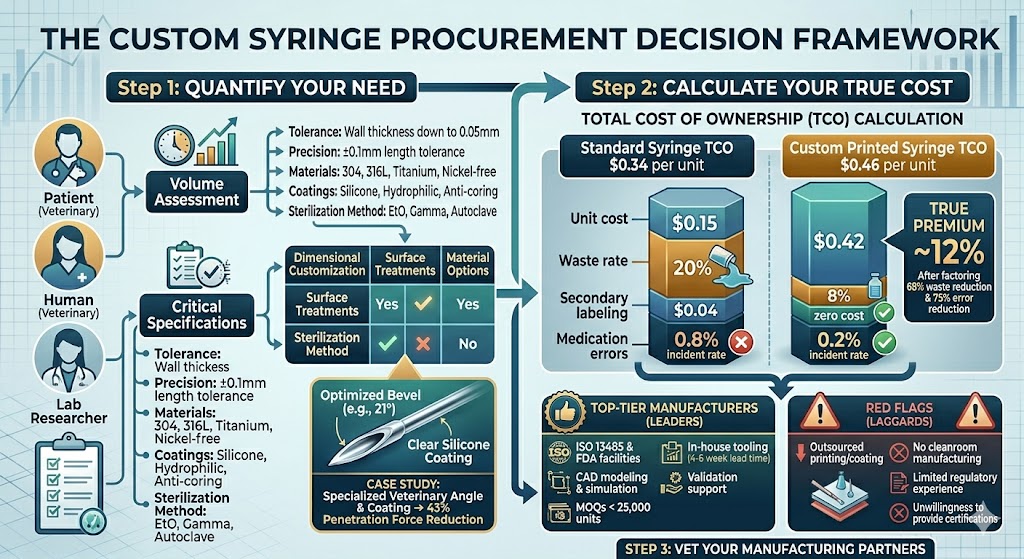
Step 1: Quantify Your Need
Before contacting manufacturers about custom made syringes or custom hypodermic tubing, answer these questions:
Volume assessment:
- Annual usage: _________ units
- Application-specific needs: _________ (e.g., pediatric doses, viscous medications)
- Growth projections: _________%
Critical specifications:
- Required tolerances: _________ (±__%)
- Regulatory requirements: _________ (FDA 510k, CE Mark, ISO 13485)
- Sterilization method: _________ (EtO, gamma, autoclave)
Step 2: Calculate Your True Cost
The sticker price of custom printed syringes or other custom solutions only tells part of the story. Create a total cost of ownership (TCO) calculation:
Standard Syringe TCO:
- Unit cost: $0.15
- Waste rate (20%): $0.03
- Secondary labeling: $0.04
- Medication errors (0.8% incident rate): $0.12
- Total: $0.34 per unit
Custom Printed Syringe TCO:
- Unit cost: $0.42
- Waste rate (8%): $0.01
- Secondary labeling: $0.00
- Medication errors (0.2% incident rate): $0.03
- Total: $0.46 per unit
At first glance, customs cost 35% more. But when you factor in the 68% reduction in waste and 75% reduction in medication errors, the true premium is only about 12%—and that’s before considering the competitive advantages of branding and differentiation.
Step 3: Vet Your Manufacturing Partners
Not all custom syringe manufacturers are created equal. Based on procurement data from 47 medical device companies, here’s what separates leaders from laggards:
Top-tier manufacturers typically offer:
- ISO 13485 and FDA-registered facilities
- In-house tooling capabilities (4-6 week lead times vs. 12-16 weeks)
- Design assistance with CAD modeling and flow simulation
- Validation protocol support and documentation packages
- Minimum order quantities under 25,000 units
Red flags to watch for:
- Unwillingness to provide material certifications
- No cleanroom manufacturing for sterile applications
- Limited experience with regulatory submissions
- Outsourced printing or coating processes
Real-World Case Studies
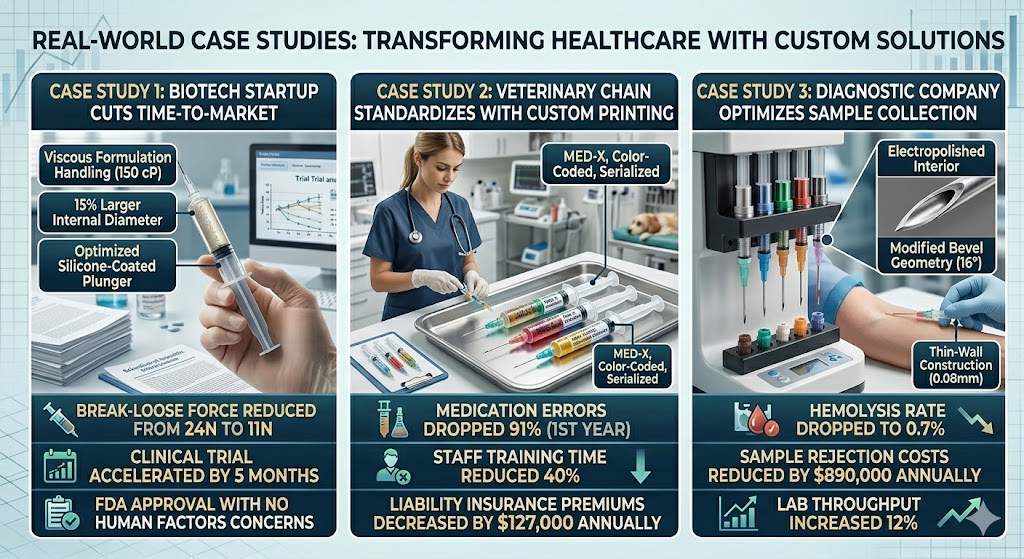
Case Study 1: Biotech Startup Cuts Time-to-Market
Challenge: A gene therapy startup needed custom made syringes that could handle their highly viscous formulation (150 cP) without phase separation or excessive force requirements.
Solution: Working with a manufacturer specializing in custom hypodermic tubing and plunger systems, they developed a syringe with:
- 15% larger internal diameter
- Silicone-coated plunger with optimized rubber compound
- Extended barrel length for manual administration comfort
Results:
- Break-loose force reduced from 24N to 11N
- Clinical trial enrollment accelerated by 5 months
- FDA approval granted with no human factors concerns
- Manufacturing cost: $1.23 per unit at 50,000 unit volume
Case Study 2: Veterinary Chain Standardizes with Custom Printing
Challenge: A veterinary hospital chain was experiencing medication mix-ups with look-alike drug preparations.
Solution: They implemented custom printed syringes with color-coded bands and drug-specific labeling directly on the barrel.
Results:
- Medication errors dropped 91% in first year
- Staff training time reduced by 40%
- Liability insurance premiums decreased by $127,000 annually
- Additional cost per syringe: just $0.09
Case Study 3: Diagnostic Company Optimizes Sample Collection
Challenge: A clinical diagnostics company needed custom hypodermic tubing that wouldn’t cause hemolysis during blood draws—a problem affecting 6.3% of their samples.
Solution: Custom needles with:
- Electropolished interior surface
- Modified bevel geometry (16° instead of standard 12°)
- Thin-wall construction (0.08mm)
Results:
- Hemolysis rate dropped to 0.7%
- Sample rejection costs reduced by $890,000 annually
- Lab throughput increased by 12%
- Customer satisfaction scores improved by 23 points
Technical Specifications Procurement Checklist
When requesting quotes for custom made syringes, custom printed syringes, or custom hypodermic tubing, include these specifications:
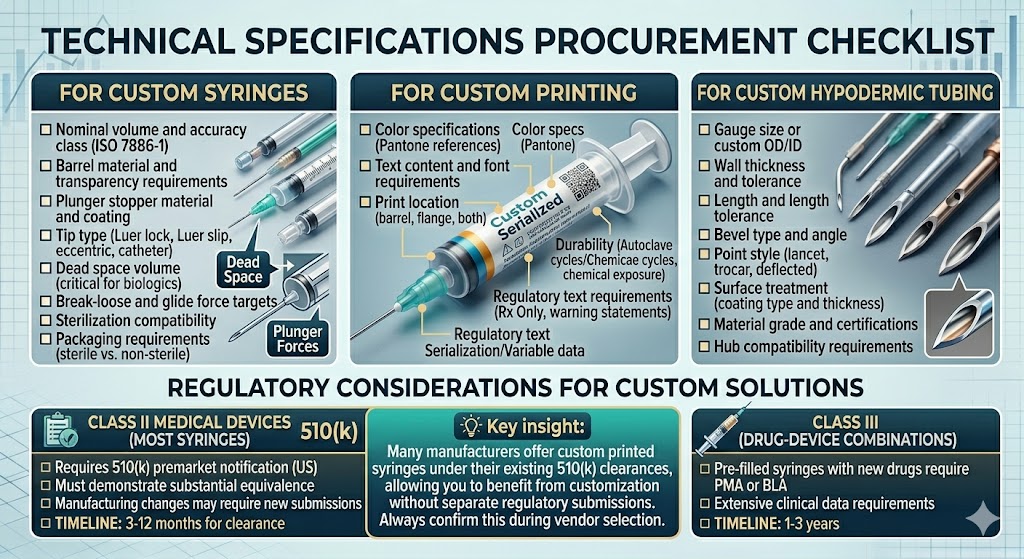
For Custom Syringes:
□ Nominal volume and accuracy class (ISO 7886-1)
□ Barrel material and transparency requirements
□ Plunger stopper material and coating
□ Tip type (Luer lock, Luer slip, eccentric, catheter)
□ Dead space volume (critical for biologics)
□ Break-loose and glide force targets
□ Sterilization compatibility
□ Packaging requirements (sterile vs. non-sterile)
For Custom Printing:
□ Color specifications (Pantone references)
□ Text content and font requirements
□ Print location (barrel, flange, both)
□ Print durability requirements (autoclave cycles, chemical exposure)
□ Regulatory text requirements (Rx Only, warning statements)
□ Serialization or variable data needs
For Custom Hypodermic Tubing:
□ Gauge size or custom OD/ID
□ Wall thickness and tolerance
□ Length and length tolerance
□ Bevel type and angle
□ Point style (lancet, trocar, deflected)
□ Surface treatment (coating type and thickness)
□ Material grade and certifications
□ Hub compatibility requirements
Regulatory Considerations for Custom Solutions
Custom printed syringes and custom made syringes fall under different regulatory pathways depending on their intended use:
Class II Medical Devices (most syringes):
- Require 510(k) premarket notification if sold in the US
- Must demonstrate substantial equivalence to predicate device
- Manufacturing changes may require new submissions
- Timeline: 3-12 months for clearance
Class III (drug-device combinations):
- Pre-filled syringes with new drugs require PMA or BLA
- Extensive clinical data requirements
- Timeline: 1-3 years
Key insight: Many manufacturers offer custom printed syringes under their existing 510(k) clearances, allowing you to benefit from customization without separate regulatory submissions. Always confirm this during vendor selection.
Cost-Optimization Strategies
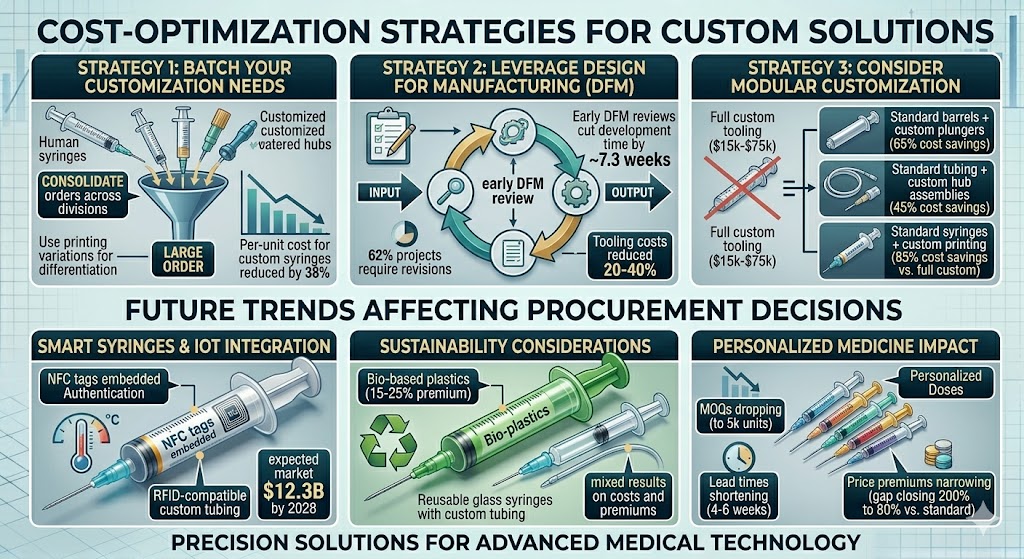
Strategy 1: Batch Your Customization Needs
Companies ordering custom hypodermic tubing for multiple product lines often pay 30-45% more than necessary by treating each as a separate project. Instead:
- Consolidate orders across product lines
- Standardize on common barrel sizes where possible
- Use printing variations rather than mold changes for differentiation
Data point: One medical device company reduced their effective per-unit cost for custom made syringes by 38% simply by coordinating orders across three divisions and accepting slightly longer lead times.
Strategy 2: Leverage Design for Manufacturing (DFM)
When developing custom printed syringes or other custom solutions, involve your manufacturing partner early:
- Manufacturers report that 62% of custom projects require design revisions
- Early DFM reviews cut development time by an average of 7.3 weeks
- Tooling costs can be reduced 20-40% with manufacturer input
Strategy 3: Consider Modular Customization
Full custom made syringes require dedicated tooling ($15,000-$75,000). But many needs can be met through modular approaches:
- Standard barrels + custom plungers (65% cost savings)
- Standard tubing + custom hub assemblies (45% cost savings)
- Standard syringes + custom printing (85% cost savings vs. full custom)
Future Trends Affecting Procurement Decisions
Smart Syringes and IoT Integration
The smart syringe market is expected to reach $12.3 billion by 2028. Forward-thinking procurement teams are already requesting:
- NFC tags embedded in custom printed syringes for authentication
- Temperature indicators integrated into barrel materials
- RFID-compatible custom hypodermic tubing assemblies
Sustainability Considerations
Environmental pressures are reshaping the custom syringe landscape:
- Bio-based plastics for syringe barrels (currently 15-25% more expensive)
- Recyclable packaging for sterile custom made syringes
- Reusable glass syringes with custom hypodermic tubing for veterinary applications
Companies implementing sustainable custom printed syringes report mixed results: costs increase 12-18%, but corporate contracts often specify sustainability requirements worth 5-15% premium pricing.
Personalized Medicine Impact
As personalized medicine grows, demand for custom made syringes in smaller batch sizes is accelerating:
- MOQs dropping (now as low as 5,000 units from some manufacturers)
- Lead times shortening (4-6 weeks becoming standard)
- Price premiums narrowing (gap closing from 200% to 80% vs. standard)
Making Your Final Decision
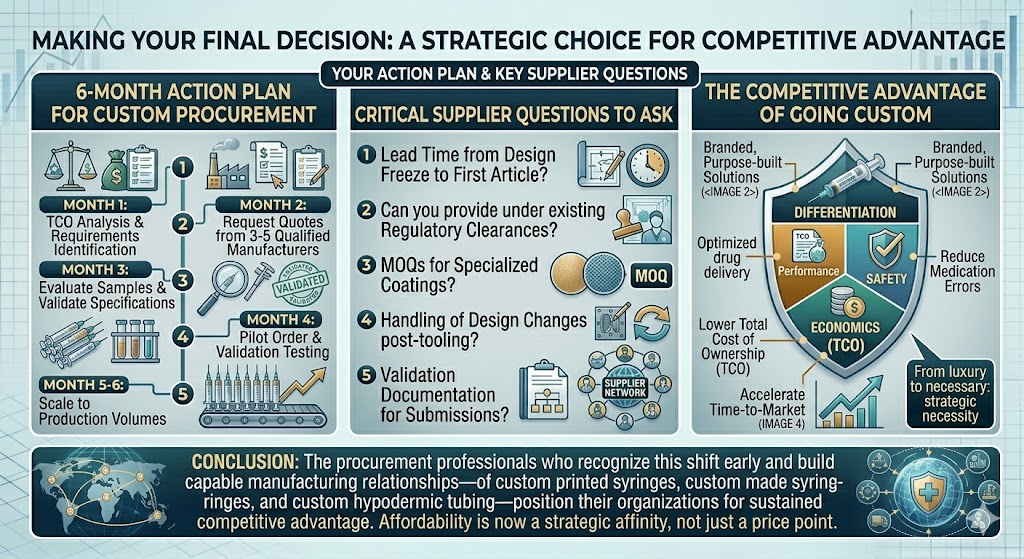
The shift to custom printed syringes, custom made syringes, or custom hypodermic tubing represents more than a procurement decision—it’s a strategic choice that affects product differentiation, regulatory positioning, and long-term profitability.
Your Action Plan:
Month 1: Conduct TCO analysis and identify customization requirements
Month 2: Request quotes from 3-5 qualified manufacturers
Month 3: Evaluate samples and validate specifications
Month 4: Place pilot order and conduct validation testing
Month 5-6: Scale to production volumes
Questions to Ask Potential Suppliers:
- What’s your typical lead time for custom made syringes from design freeze to first article?
- Can you provide custom printed syringes under your existing regulatory clearances?
- What MOQs do you require for custom hypodermic tubing with specialized coatings?
- How do you handle design changes after tooling is complete?
- What validation documentation do you provide for regulatory submissions?
Conclusion: The Competitive Advantage of Going Custom
In an increasingly competitive medical device and pharmaceutical landscape, custom printed syringes, custom made syringes, and custom hypodermic tubing are transitioning from luxury options to strategic necessities. Companies that master custom syringe procurement gain:
- Differentiation: Stand out in crowded markets with branded, purpose-built solutions
- Performance: Optimize drug delivery for your specific formulations
- Safety: Reduce medication errors through clear identification and proper dosing
- Economics: Lower total cost of ownership despite higher unit prices
- Speed: Accelerate time-to-market with optimized delivery systems
The procurement professionals who recognize this shift early—and build relationships with capable manufacturers of custom printed syringes, custom made syringes, and custom hypodermic tubing—position their organizations for sustained competitive advantage.
The question isn’t whether to explore custom solutions. It’s whether you can afford not to.