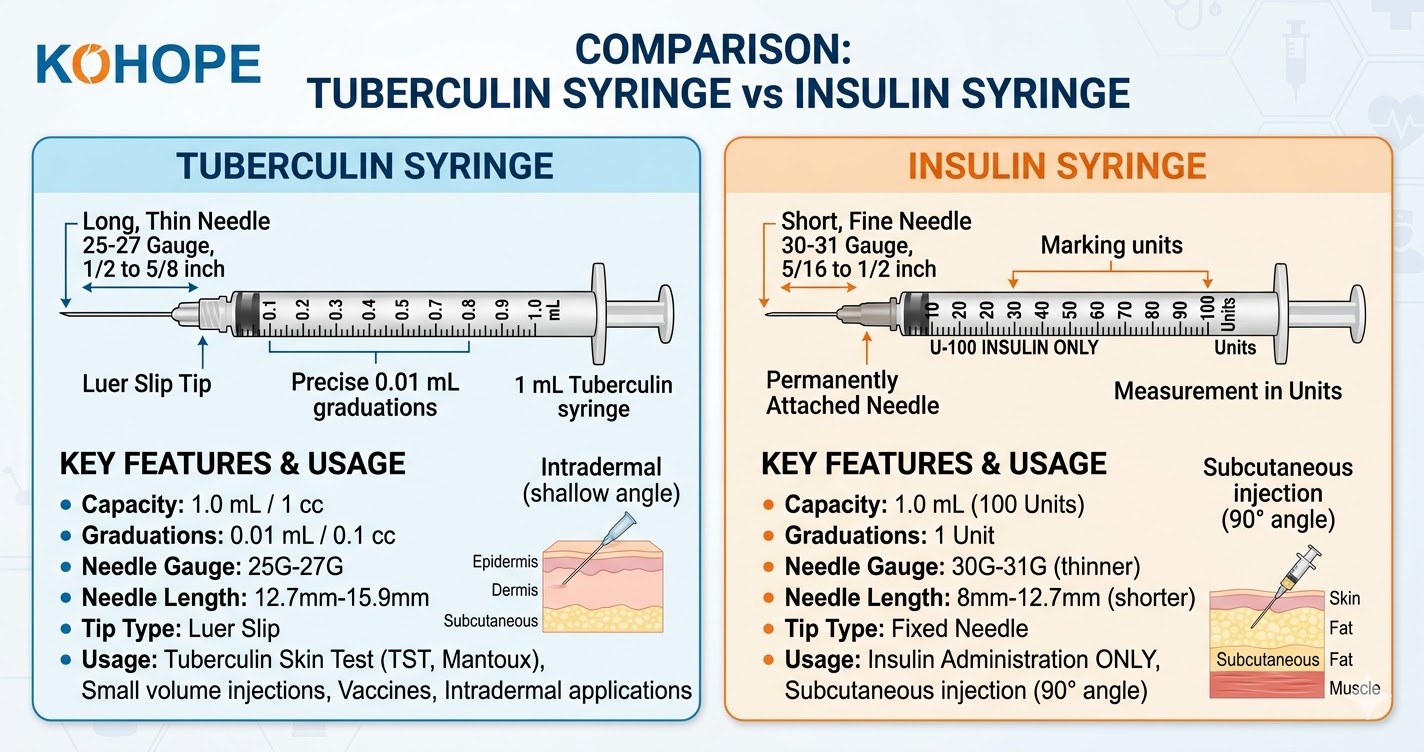
In medical practice, selecting the correct syringe is critical for accurate dosing and patient safety. Among small-volume syringes, two commonly used types are tuberculin syringes and insulin syringes.
While these syringes may appear similar at first glance, they serve distinctly different clinical purposes and utilize different measurement systems. Tuberculin syringes measure medication in milliliters (mL), while insulin syringes measure in insulin units—a crucial difference that directly impacts dosing accuracy.
Understanding these differences helps healthcare professionals prevent medication errors and select the appropriate syringe for specific treatments. For a comprehensive overview of different injection devices, explore our complete selection of medical syringes designed for various clinical applications.
What Is a Tuberculin Syringe?
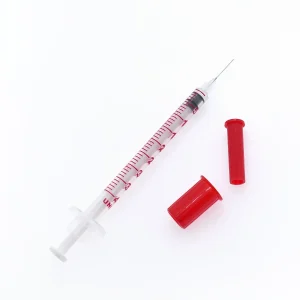
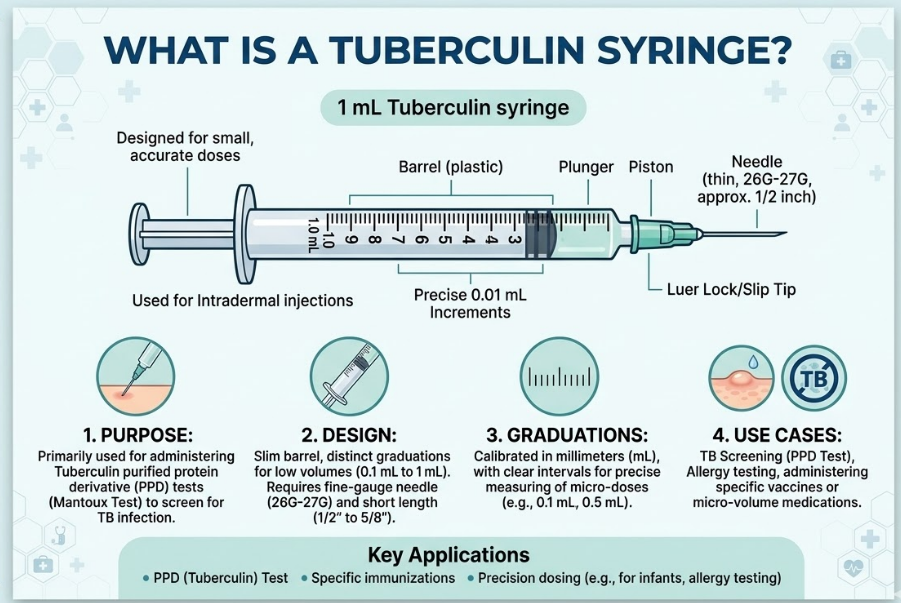
A tuberculin syringe is a precision 1 mL syringe designed for measuring very small medication volumes, particularly for intradermal injections.
Originally developed for administering the tuberculin skin test (TST), also known as the Mantoux test, this syringe helps diagnose tuberculosis exposure. During the test, healthcare professionals inject 0.1 mL of purified protein derivative (PPD) into the dermal layer of the skin.
Common Applications
Healthcare providers rely on tuberculin syringes for:
- Tuberculosis skin testing (Mantoux test)
- Allergy testing and immunotherapy
- Intradermal injections requiring precise volume control
- Small-dose medications under 1 mL
- Pediatric vaccinations and diagnostic procedures
- Research applications requiring exact measurements
Technical Specifications
| Feature | Tuberculin Syringe |
|---|---|
| Capacity | 1 mL |
| Measurement Scale | Milliliters (0.01 or 0.1 mL increments) |
| Needle Gauge | 25–27G |
| Needle Length | Approximately 16 mm (5/8 inch) |
| Primary Injection Route | Intradermal |
| Barrel Design | Narrow for precise measurement |
The narrow barrel design enables healthcare professionals to accurately measure minute volumes, making it ideal for diagnostic and therapeutic injections where precision is paramount.
What Is an Insulin Syringe?
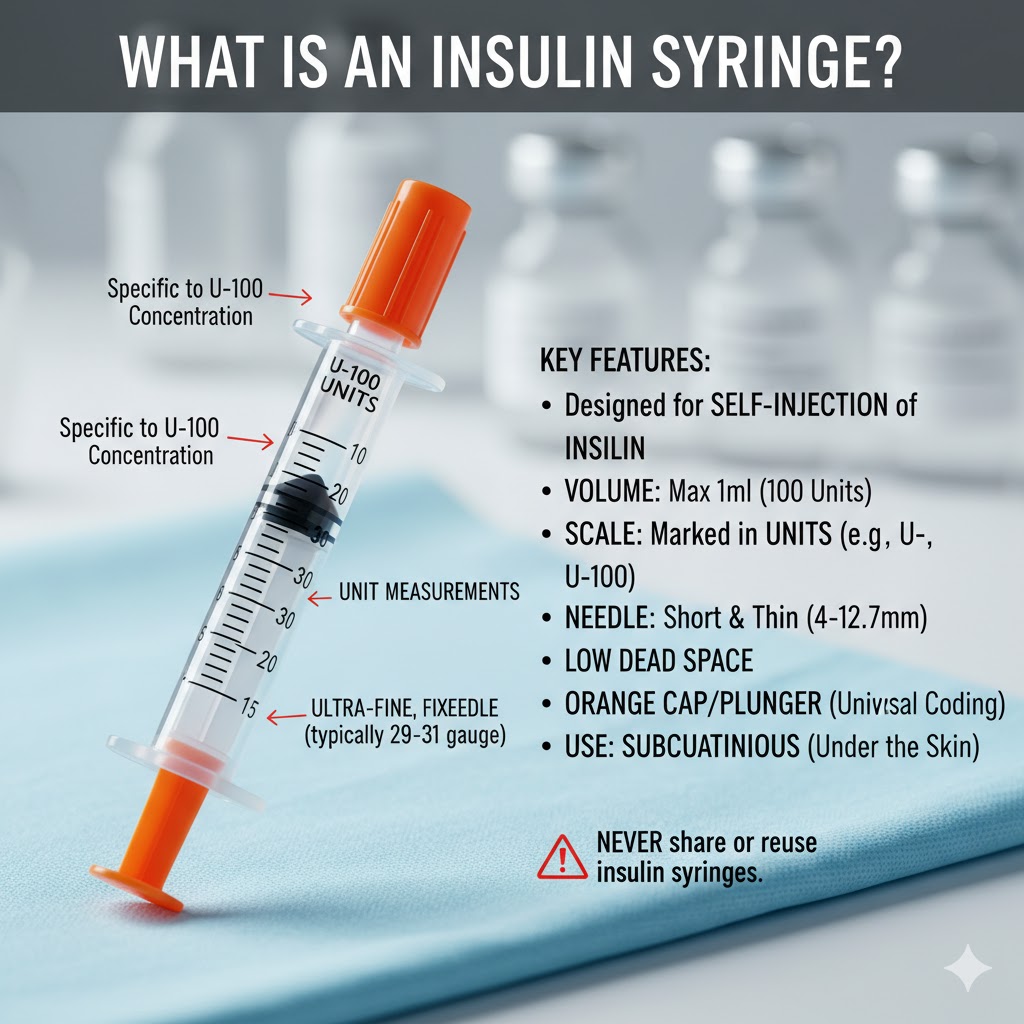
An insulin syringe is specifically engineered for administering insulin to individuals with diabetes.
Unlike standard syringes, insulin syringes are calibrated in units rather than milliliters, allowing patients and healthcare providers to measure insulin doses directly without mathematical conversion.
Understanding U-100 Insulin
Most modern insulin products are U-100 insulin, which means:
- 100 units of insulin per 1 milliliter of solution
Therefore:
- 1 insulin unit = 0.01 mL
- 10 insulin units = 0.1 mL
- 100 insulin units = 1.0 mL
Common Uses
Patients and healthcare providers use insulin syringes for:
- Subcutaneous insulin injection for diabetes management
- Type 1 and Type 2 diabetes daily therapy
- Multiple daily injections (MDI) regimens
- Basal-bolus insulin therapy
- Gestational diabetes treatment
Standard Insulin Syringe Sizes
| Syringe Capacity | Maximum Insulin Dose | Best For |
|---|---|---|
| 0.3 mL | 30 units | Low-dose insulin users, children |
| 0.5 mL | 50 units | Moderate-dose insulin regimens |
| 1.0 mL | 100 units | Higher-dose requirements |
Insulin syringes typically feature ultra-thin needles (28–31 gauge) to minimize discomfort, as patients often require multiple daily injections.
Tuberculin Syringe vs Insulin Syringe: Key Differences
While these syringes may look similar, they differ significantly in design, calibration, and clinical application.
Comprehensive Comparison Table
| Feature | Tuberculin Syringe | Insulin Syringe |
|---|---|---|
| Primary Purpose | Diagnostic testing and precise small-volume dosing | Insulin administration for diabetes |
| Calibration System | Milliliters (mL) | Insulin units (U) |
| Standard Capacity | 1 mL | 0.3 mL, 0.5 mL, or 1.0 mL |
| Needle Gauge | 25–27G (thicker) | 28–31G (ultra-thin) |
| Needle Length | ~16 mm (5/8 inch) | 8–12.7 mm (shorter) |
| Injection Route | Intradermal (into skin layer) | Subcutaneous (under skin) |
| Typical Users | Healthcare professionals | Patients and healthcare providers |
| Measurement Precision | 0.01–0.1 mL increments | 1–2 unit increments |
| Color Coding | Usually clear/standard | Often color-coded by size |
The Critical Distinction: Measurement Scale
The most important difference is the measurement system:
- Tuberculin syringes measure liquid volume in milliliters
- Insulin syringes measure insulin dosage in standardized units
This fundamental difference makes these syringes non-interchangeable for their respective purposes.
Why These Syringes Should Never Be Interchanged
Using the wrong syringe type can result in serious medication errors with potentially life-threatening consequences.
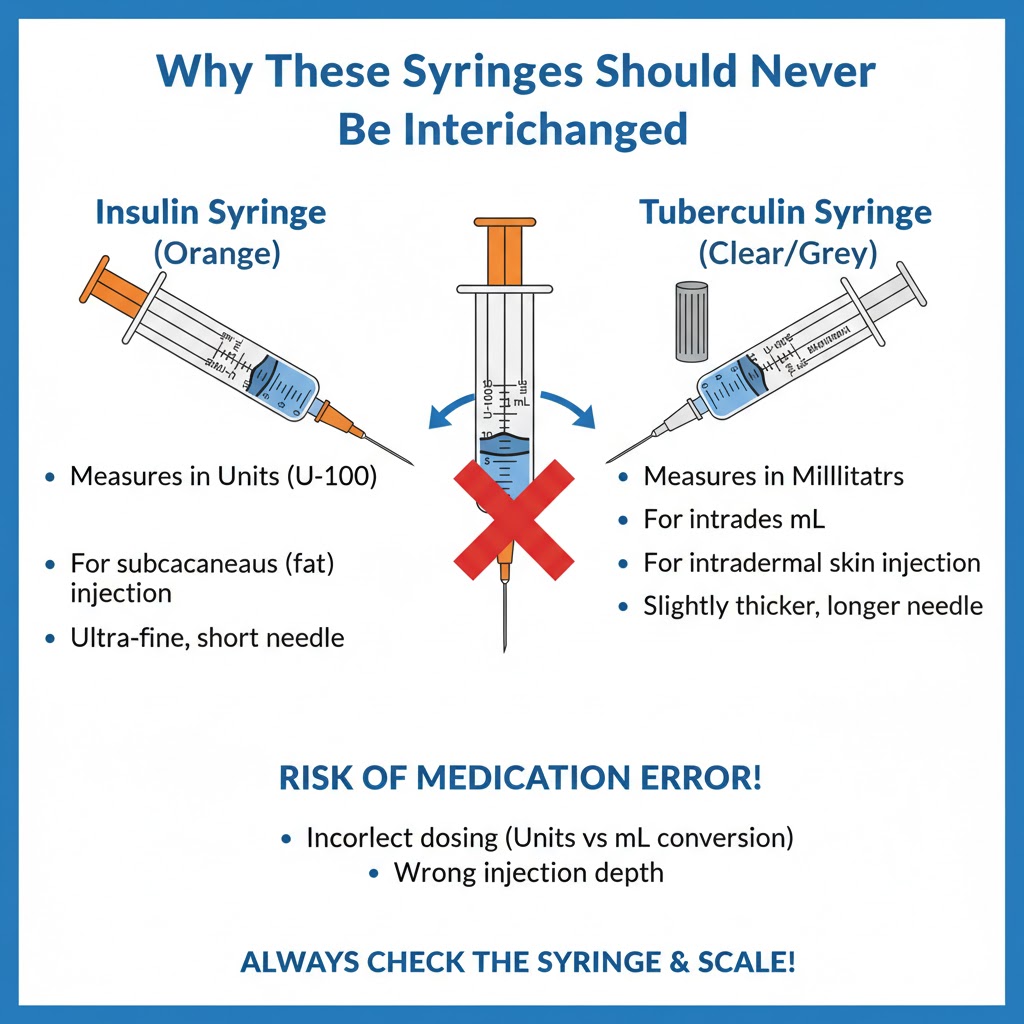
The Dosing Error Risk
Tuberculin syringes are marked in milliliters, not insulin units, making them unsuitable for accurate insulin dosing.
Critical Example:
If a healthcare provider mistakenly uses a tuberculin syringe for insulin:
- 0.5 mL drawn in a tuberculin syringe
- Could be misinterpreted as 50 units of insulin
- Actual amount = 50 units of U-100 insulin
- But if the prescription was for 5 units, this represents a 10-fold overdose
Such errors can cause:
- Severe hypoglycemia (dangerously low blood sugar)
- Loss of consciousness
- Seizures
- Potentially fatal outcomes
Clinical Guidelines
Healthcare guidelines, including those from the Institute for Safe Medication Practices (ISMP) and the American Diabetes Association (ADA), strongly recommend:
✓ Always use insulin-specific syringes for insulin administration
✓ Never substitute tuberculin syringes for insulin dosing
✓ Educate patients on proper syringe selection
✓ Implement safety checks in clinical settings
Needle Gauge and Patient Comfort
Needle size represents another key difference affecting patient experience.
Needle Gauge Comparison
| Syringe Type | Typical Needle Gauge | Needle Thickness | Primary Reason |
|---|---|---|---|
| Tuberculin | 25–27G | Moderately thin | Accurate intradermal placement |
| Insulin | 28–31G | Ultra-thin | Minimize pain for frequent injections |
Understanding Gauge Numbers:
- Higher gauge numbers = thinner needles
- Lower gauge numbers = thicker needles
Why Insulin Needles Are Thinner
Insulin syringes use thinner needles (higher gauge) because:
- Frequency of Use: Patients may inject insulin 4–6 times daily
- Pain Reduction: Thinner needles cause less tissue trauma
- Patient Compliance: Reduced discomfort improves treatment adherence
- Subcutaneous Injection: Doesn’t require the same penetration depth as intradermal
Why Tuberculin Needles Are Slightly Thicker
Tuberculin syringes use moderately thin needles because:
- Intradermal Precision: Requires controlled penetration into the dermal layer
- Medication Delivery: Must create a visible wheal (raised area) on the skin
- Professional Use: Typically administered by trained healthcare providers
- Infrequent Administration: Not designed for daily patient self-injection
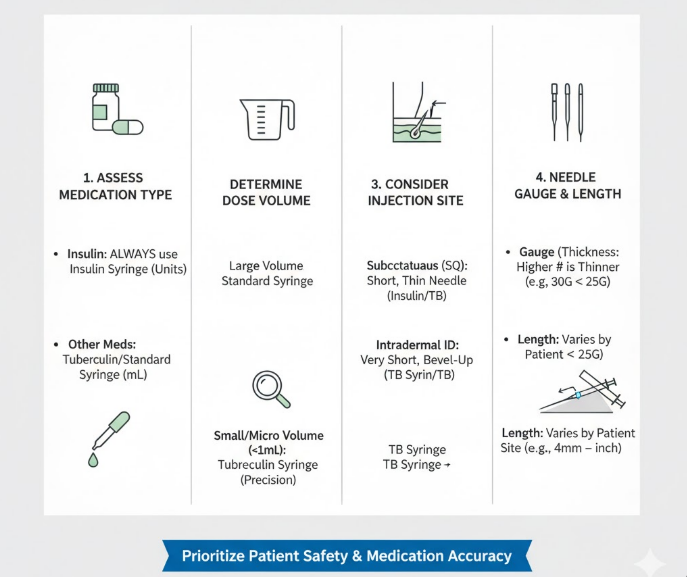
How to Choose the Right Syringe
Healthcare professionals should consider multiple factors when selecting the appropriate syringe.
1. Medication Type
Decision Tree:
- Administering insulin? → Use insulin syringe only
- Performing tuberculin skin test? → Use tuberculin syringe
- Allergy testing? → Use tuberculin syringe
- Small-volume medication (<1 mL)? → Consider tuberculin syringe if not insulin
2. Required Dose Precision
Tuberculin syringes provide:
- Fine milliliter measurements (0.01 mL increments)
- Ideal for medications requiring exact volumes
- Critical for diagnostic procedures
Insulin syringes provide:
- Unit-based measurements (1–2 unit increments)
- Designed specifically for insulin concentration standards
- Simplified dosing without conversion calculations
3. Injection Route
| Injection Type | Recommended Syringe | Purpose |
|---|---|---|
| Intradermal | Tuberculin syringe | Skin testing, allergen testing |
| Subcutaneous (insulin) | Insulin syringe | Diabetes management |
| Subcutaneous (other medications) | Tuberculin or standard syringe | Depending on volume |
| Intramuscular | Standard syringe (larger volume) | Vaccines, medications |
4. Patient Comfort and Self-Administration
Consider:
- Patients self-injecting insulin benefit from ultra-thin insulin needles
- Comfort features encourage better treatment compliance
- Shorter needle lengths reduce injection anxiety
- Color-coded insulin syringes help prevent dosing errors
5. Regulatory and Safety Compliance
Ensure:
- FDA-approved syringes for intended use
- Compliance with institutional protocols
- Proper staff training on syringe selection
- Clear labeling and storage separation
Best Practices for Healthcare Providers
Storage and Organization
- Separate Storage: Keep insulin syringes and tuberculin syringes in clearly labeled, separate locations
- Color Coding: Use institutional color-coding systems to prevent mix-ups
- Access Control: Limit access to medication preparation areas to trained staff
- Inventory Management: Regularly audit syringe supplies
Training and Education
- Staff Training: Ensure all healthcare providers understand syringe differences
- Patient Education: Teach diabetic patients proper insulin syringe use
- Visual Aids: Use comparison charts in clinical areas
- Competency Assessment: Regularly test staff knowledge
Error Prevention Strategies
- Double-Check Protocol: Verify syringe type before medication preparation
- Barcode Scanning: Implement technology to prevent wrong syringe selection
- Standardized Protocols: Develop clear institutional guidelines
- Incident Reporting: Create non-punitive error reporting systems

Conclusion
Although tuberculin syringes and insulin syringes may appear similar, they are engineered for distinctly different medical purposes with critical distinctions in:
✓ Measurement system (milliliters vs. insulin units)
✓ Needle gauge and length (comfort and injection route)
✓ Syringe capacity (volume requirements)
✓ Clinical applications (diagnostic vs. therapeutic)
✓ Safety features (designed for specific medications)
Key Takeaway: Using the correct syringe ensures accurate dosing, safe treatment delivery, and improved patient outcomes while preventing potentially dangerous medication errors.
For healthcare providers and medical distributors, understanding these differences is essential when selecting or sourcing medical syringes for clinical use. Proper syringe selection is not merely a matter of convenience—it’s a critical component of patient safety.
Frequently Asked Questions (FAQ)
Can a tuberculin syringe be used for insulin?
No. Tuberculin syringes are calibrated in milliliters, while insulin syringes measure insulin units. Using a tuberculin syringe for insulin significantly increases the risk of dosing errors that could result in severe hypoglycemia or hyperglycemia. Healthcare guidelines explicitly recommend using only insulin-specific syringes for insulin administration.
Why are insulin syringes measured in units instead of milliliters?
Insulin is standardized based on concentration (such as U-100 insulin, meaning 100 units per mL). Measuring doses in units allows direct and accurate dosing without requiring patients to perform mathematical conversions. This unit-based system:
- Reduces calculation errors
- Simplifies patient self-administration
- Standardizes dosing across different insulin types
- Improves medication safety
What size syringe is used for insulin?
Common insulin syringe sizes include:
- 0.3 mL (30 units): Best for low-dose insulin users, children, and those requiring precise small doses
- 0.5 mL (50 units): Suitable for moderate insulin doses, commonly used by many diabetic patients
- 1.0 mL (100 units): Designed for higher insulin dose requirements
The appropriate size depends on the prescribed insulin dose. Using a syringe that matches your typical dose allows for more accurate measurement.
Are tuberculin syringes and insulin syringes interchangeable?
Absolutely not. These syringes are designed for different purposes and use incompatible measurement systems. Interchanging them can result in serious medication errors, including:
- Incorrect dosing (often by a factor of 10 or more)
- Severe adverse effects
- Treatment failure
- Potential hospitalization or death
Always use the syringe specifically designed for the medication being administered.
What needle gauge is best for insulin injections?
Most insulin syringes use 28–31 gauge needles, with 31G being among the thinnest available. Thinner needles (higher gauge numbers):
- Cause less pain
- Reduce tissue trauma
- Improve patient compliance
- Are suitable for frequent daily injections
The specific gauge may vary based on patient preference and insulin viscosity.
How do I read a tuberculin syringe?
Tuberculin syringes are marked in milliliters with fine graduations:
- Major markings: Usually at 0.1 mL intervals (0.1, 0.2, 0.3, etc.)
- Minor markings: Often at 0.01 mL intervals for precise measurement
- Total capacity: 1.0 mL
To read accurately, align the top of the plunger (not the rubber tip) with the desired measurement marking at eye level.
Can I buy insulin syringes without a prescription?
In most U.S. states, insulin syringes are available over-the-counter without a prescription at pharmacies. However, regulations vary by state:
- Some states require a prescription
- Some pharmacies have internal policies requiring prescriptions
- Bulk purchases may have additional requirements
Contact your local pharmacy to confirm their specific policies.
What’s the difference between U-100 and U-500 insulin syringes?
- U-100 syringes: Designed for U-100 insulin (100 units/mL), the most common insulin concentration
- U-500 syringes: Specifically calibrated for U-500 insulin (500 units/mL), a highly concentrated insulin
Critical Safety Note: Never use U-100 syringes with U-500 insulin, as this can result in a five-fold dosing error. Always match the syringe to the insulin concentration.
Additional Resources
For more information on proper syringe selection and medical injection supplies:
- Browse our complete range of medical syringes
- Learn more about tuberculin syringes for diagnostic testing
- Explore insulin syringes designed for diabetes management
Medical Disclaimer: This article is for informational purposes only and does not constitute medical advice. Always consult with qualified healthcare professionals regarding medication administration, dosing, and proper injection techniques. Individual clinical situations may require specific considerations beyond the scope of this general information.