Understanding syringe measurements, needle gauges, and choosing the right insulin syringe for your needs
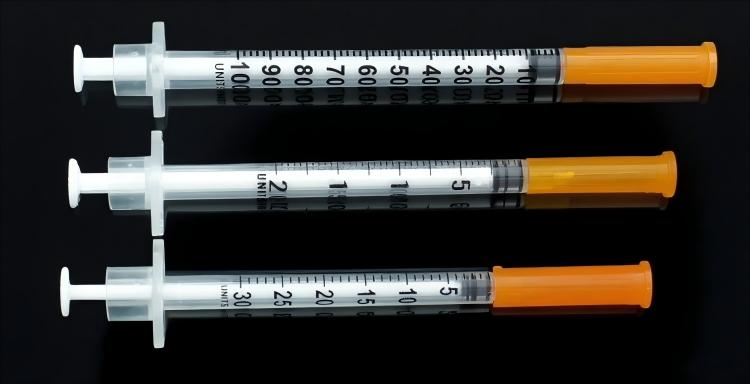
If you’re new to insulin therapy or diabetes care, the world of insulin syringes can feel overwhelming. What does “1ml” mean? Why are there so many needle sizes? And how do you choose the right one? Don’t worry – this guide will walk you through everything in plain language, helping you understand insulin syringe sizes like a pro.
Understanding the Basics: What Do Those Numbers Mean?
Decoding Syringe Capacity (ml, cc, and units)
Let’s start with the most confusing part – the different ways we measure syringe volume.
What is “ml”?
“ml” stands for milliliter, which is a metric unit of volume. Think of it like measuring liquid in a tiny cup. One milliliter equals about 20 drops of water. When you see a 0.3 ml insulin syringe, it means that syringe can hold up to 0.3 milliliters of liquid.
What about “cc”?
Here’s good news: 1 ml = 1 cc (cubic centimeter). They’re exactly the same! You might see a 30cc insulin syringe or a 30ml syringe – they’re identical. Medical professionals use both terms interchangeably, though “ml” is more common today.
And those “units”?
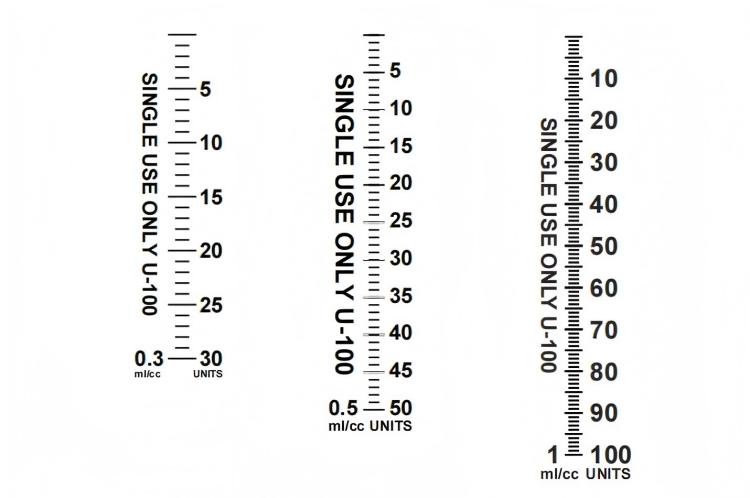
This is where it gets specific to insulin. Insulin is measured in units (U), and most insulin in the world comes in U-100 concentration, meaning 100 units per milliliter. So:
- A 0.3 ml syringe holds up to 30 units
- A 0.5 ml syringe holds up to 50 units
- A 1 ml syringe holds up to 100 units
The syringe barrel shows unit markings, not ml markings, making it easier to measure your insulin dose.
Understanding Needle Gauge: Why Higher Numbers Mean Thinner Needles
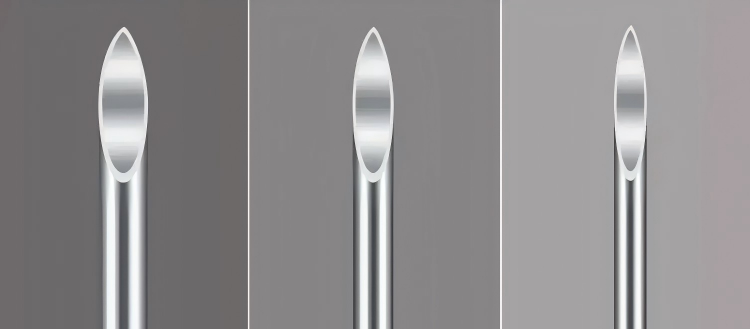
Now let’s talk about needle thickness, measured in “gauge” (abbreviated as “G”).
The counter-intuitive part: The gauge system works backwards from what you might expect. A 27g insulin syringe has a thicker needle than a 31g insulin syringe. Think of it like this – the gauge number tells you how many needles would fit side-by-side in a certain space. More needles fitting means each one is thinner!
Here’s a simple visual comparison:
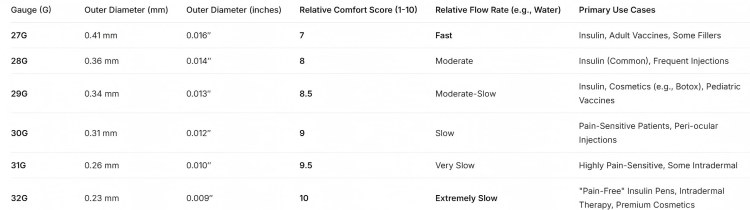
- 27G = about 0.4mm diameter (thickest in insulin syringes)
- 28G = about 0.36mm diameter
- 29G = about 0.33mm diameter
- 30G = about 0.3mm diameter
- 31G = about 0.25mm diameter (thinnest common size)
- 32G = about 0.23mm diameter (ultra-fine)
Needle Length Matters Too
Insulin syringe needles typically come in these lengths:
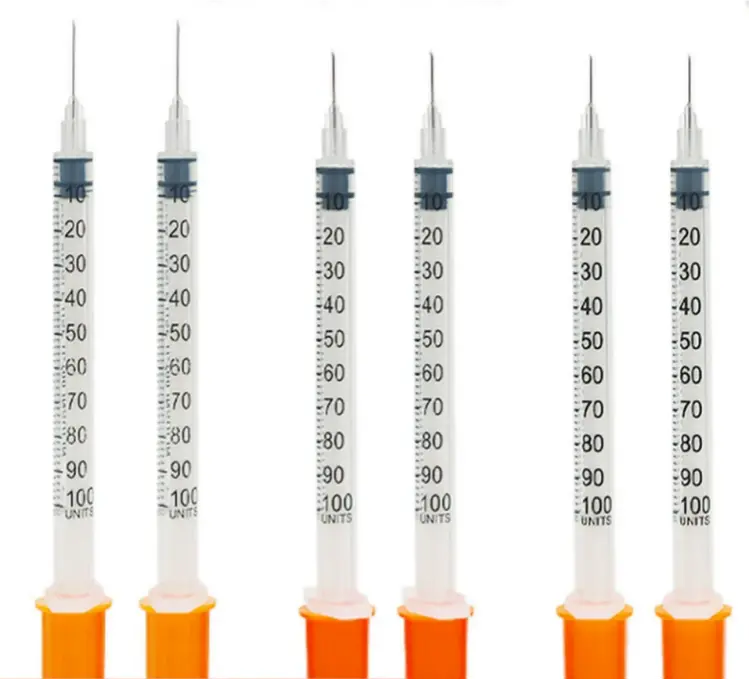
- 6mm (1/4 inch) – Short
- 8mm (5/16 inch) – Medium
- 12.7mm (1/2 inch) – Long
Most people use 6mm or 8mm needles today, as they’re long enough to reach subcutaneous tissue (just under the skin where insulin goes) without going too deep.
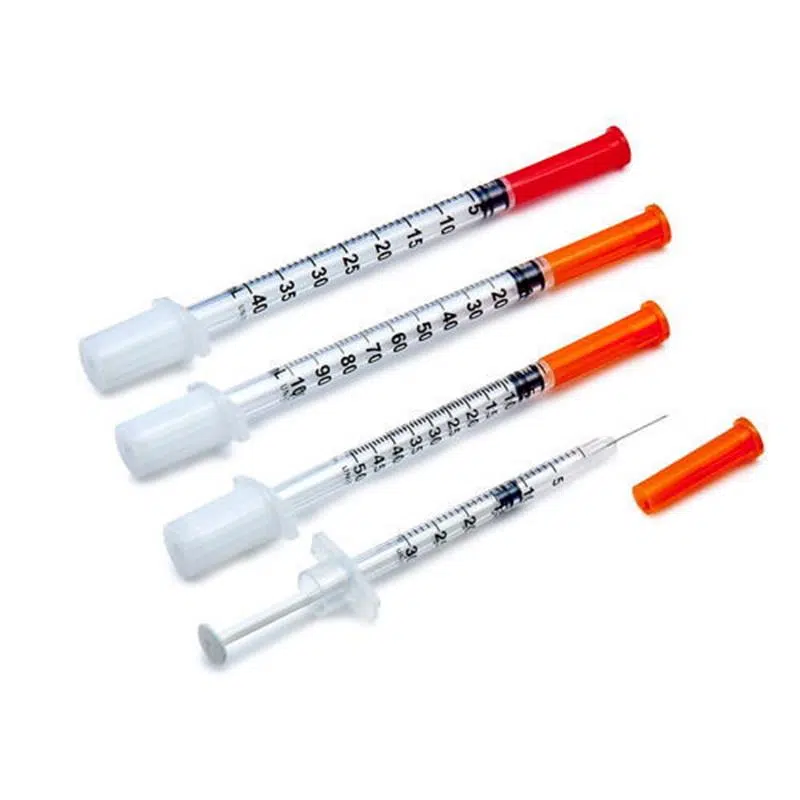
Complete Guide to Insulin Syringe Sizes
Ultra-Small Capacity: 0.25ml (25 Unit) Syringes
Who needs this size?
The 0.25ml insulin syringe is relatively rare but incredibly useful for very young children or patients requiring extremely precise, small doses. Each marking typically represents 0.5 units, allowing for very fine dose adjustments.
Application scenarios:
- Pediatric diabetes care (infants and toddlers)
- Patients with high insulin sensitivity
- Very precise dose titration during initial therapy
- Small pets requiring insulin (veterinary use)
Available needle options: Usually paired with 31G or 32G ultra-fine needles in 6mm length
Latex compatibility: Standard insulin syringes use synthetic rubber gaskets (not natural latex) in the plunger, making them safe for latex-allergic patients
Small Capacity: 0.3ml (30 Unit) Syringes
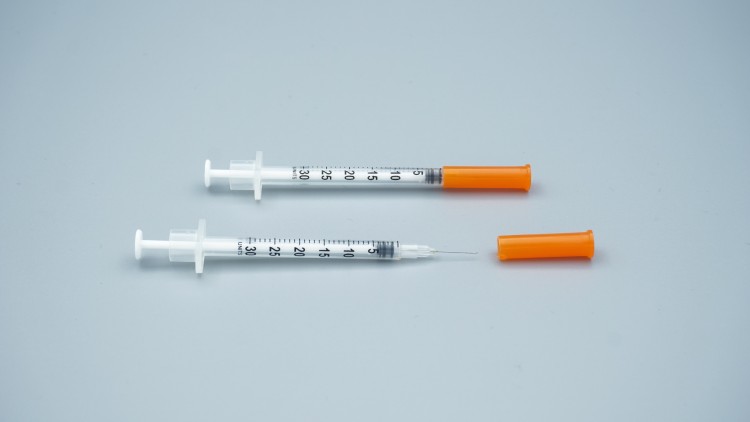
Understanding the 0.3ml insulin syringe
The 0.3 ml insulin syringe is designed for low-dose insulin administration. These syringes typically have 1-unit markings (some even have half-unit markings), making them perfect when precision matters most.
Who should use a 0.3ml syringe?
- Children and adolescents with lower insulin requirements
- Adults taking less than 30 units per injection
- Patients on insulin pump therapy who occasionally need manual injections
- Anyone who struggles to read smaller markings on larger syringes
Real-world application: Imagine a 7-year-old newly diagnosed with Type 1 diabetes. Their morning insulin dose might be just 4 units. On a 0.3 ml insulin syringe, those 4 units are clearly marked and easy to measure accurately. On a 1ml syringe, the same dose would occupy a tiny portion of the barrel, making accurate measurement much harder.
Common needle configurations:
- 30G x 8mm (most popular)
- 31G x 6mm (extra comfort)
- 29G x 12.7mm (for patients with more body fat)
Latex information: Modern syringes use latex-free materials throughout, including the plunger tip
Medium Capacity: 0.5ml (50 Unit) Syringes
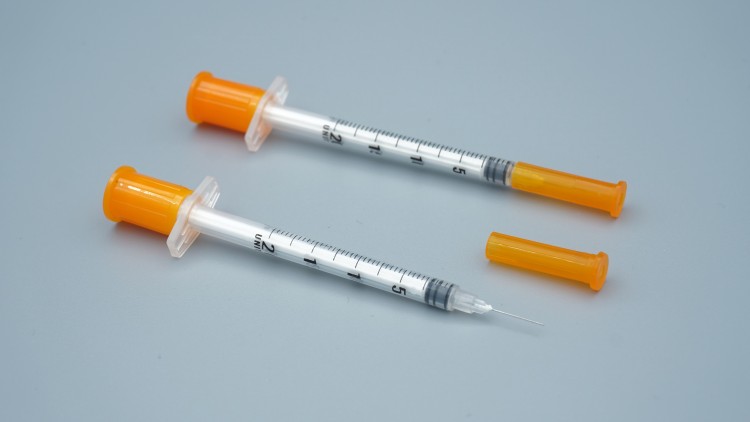
The most versatile option
The 0.5 ml insulin syringe is the “Goldilocks” of insulin syringes – not too big, not too small, just right for most adults. This is the most commonly prescribed and stocked insulin syringe worldwide.
Perfect for:
- Adults with moderate insulin requirements (up to 50 units per dose)
- Most Type 2 diabetes patients on basal insulin
- Standard hospital and clinic use
- Travel kits (balances capacity with compact size)
Why healthcare providers love the 0.5ml size: The scale markings are clearly spaced, reducing dosing errors. Each line typically represents 1 unit, and even patients with vision challenges can usually read them without difficulty. The barrel length is comfortable to handle without being bulky.
Typical daily scenario: An adult with Type 2 diabetes takes 24 units of long-acting insulin before bed. A 0.5 ml insulin syringe is ideal – the dose sits clearly in the middle of the barrel, easy to measure and easy to verify before injection.
Available in multiple needle configurations:
- 28G x 8mm (balanced comfort and flow)
- 29G x 6mm (shorter needle, good comfort)
- 30G x 8mm (enhanced comfort)
- 31G x 6mm (maximum comfort for sensitive patients)
Material safety: All components are latex-free; the plunger gasket uses synthetic elastomers
Standard Capacity: 1ml (100 Unit) Syringes
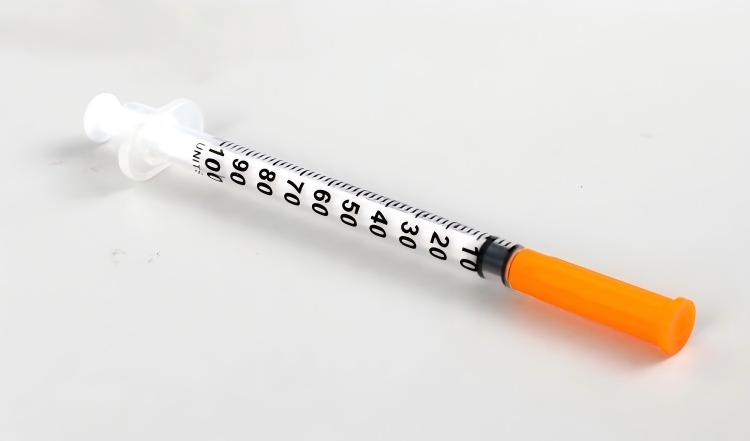
Full capacity for higher doses
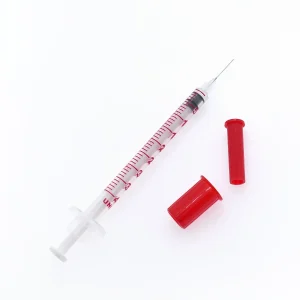
The 1 ml insulin syringe is the standard full-size option, holding up to 100 units of U-100 insulin. Despite the larger capacity, these maintain the same quality and precision as smaller syringes.
Ideal users:
- Patients requiring 50-100 units per injection
- Mixed insulin regimens (combining two insulin types in one syringe)
- Type 2 diabetes patients with significant insulin resistance
- Patients who prefer using one syringe rather than splitting doses
Real-world example: Consider someone taking 70 units of basal insulin daily. With a 1 ml insulin syringe, they can draw their full dose in one syringe. With a 0.5ml syringe, they’d need two injections, which means more needle sticks and more supplies.
Important consideration:
The scale on a 1ml insulin syringe has markings for all 100 units, typically with lines at every 2 units and numbers at every 10 units. This means the spacing is tighter than smaller syringes. Patients with visual impairments might find smaller capacity syringes easier to read for lower doses.
Common needle options:
- 27G x 12.7mm (traditional standard)
- 28G x 8mm (modern preference)
- 29G x 12.7mm (comfort with longer reach)
- 30G x 8mm (good balance)
Latex compatibility: Manufactured with latex-free materials; safe for all patients
Large Volume: 3ml (300 Unit) Syringes
Specialized applications
The 3ml insulin syringe is less common for human insulin therapy but serves important roles in specific situations.
Primary uses:
- Veterinary medicine (larger animals requiring higher insulin doses)
- Compounded insulin preparations
- Research and laboratory settings
- Specialized endocrinology protocols
Note for patients: If your doctor prescribes doses requiring a 3ml syringe for regular insulin use, it’s worth discussing whether your insulin regimen could be optimized or whether insulin pens might be more appropriate.
Needle specifications: Usually 25G to 27G with lengths from 12.7mm to 16mm
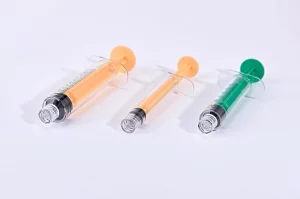
Extra-Large Volume: 5ml, 10ml, 20ml, and 30cc Syringes
Beyond standard insulin therapy
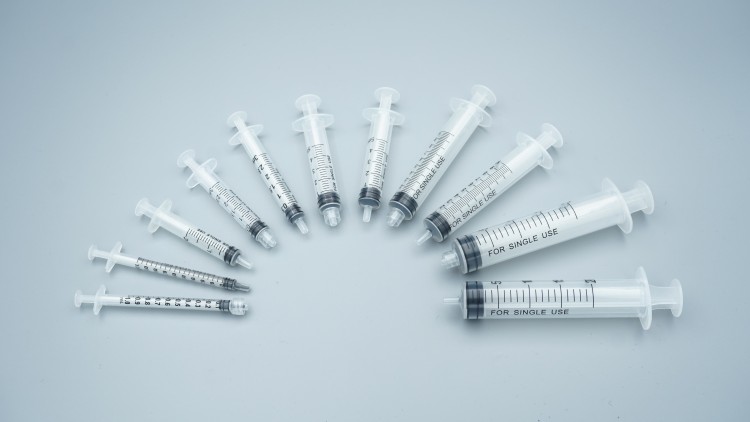
When we get into 5ml, 10ml, 20ml, and 30cc insulin syringe sizes, we’re moving beyond typical subcutaneous insulin injection territory.
Where these sizes are used:
5ml Syringes:
- Veterinary insulin administration for large animals
- Subcutaneous fluid administration
- Mixing and preparing medication solutions
10ml Syringes:
- Large animal veterinary care
- Medical procedures requiring volume measurement
- Laboratory and research applications
20ml Syringes:
- Primarily veterinary applications
- Wound irrigation
- Tube feeding preparations
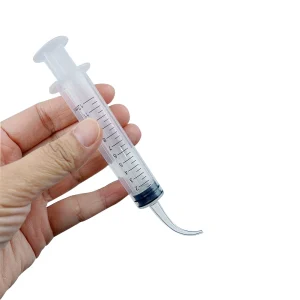
30cc (30ml) Insulin Syringe:
- Large animal veterinary practice (horses, cattle)
- Industrial and laboratory use
- Fluid administration in specialized medical procedures
Important note: These larger syringes are generally not suitable for human insulin injection as the volume far exceeds normal insulin dosing. If you’re researching these sizes, make sure you understand the intended application.
Material specifications: Larger syringes may use different materials than standard insulin syringes; verify latex-free status if allergies are a concern
Needle Gauge Deep Dive: Choosing Your Comfort Level
27G Insulin Syringes: The Traditional Standard
What to expect:
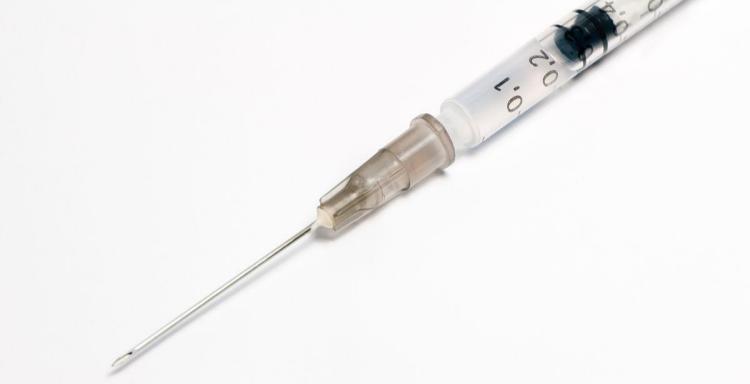
A 27g insulin syringe uses the thickest needle commonly available for insulin injection today. At approximately 0.4mm diameter, it’s still quite thin – much thinner than needles used for vaccines or blood draws.
Advantages:
- Fastest insulin flow rate (quicker injection)
- Needle strength (less likely to bend)
- Easier for people with arthritis or reduced hand strength
- Long track record of reliability
Best for:
- Patients who need to inject thicker insulin preparations
- People who prefer quick injections
- Those transitioning from older, larger needles
- Patients with very steady hands
Comfort level: Moderate – most patients tolerate well, but you’ll feel the needle more than with thinner gauges
28G Insulin Syringes: The Balanced Choice
The middle ground
A 28g insulin syringe offers a noticeable comfort improvement over 27G while maintaining good insulin flow.
Why choose 28G:
- Better comfort than 27G
- Still provides quick injection
- Good needle strength
- Widely available and affordable
Perfect for:
- First-time insulin users
- Patients wanting better comfort than 27G without going ultra-thin
- Situations where injection speed matters
- Standard clinical settings
Patient feedback: Many describe this as the “don’t really notice it” gauge – thin enough for comfort, substantial enough for confidence
29G Insulin Syringes: Enhanced Comfort
Moving into comfort territory
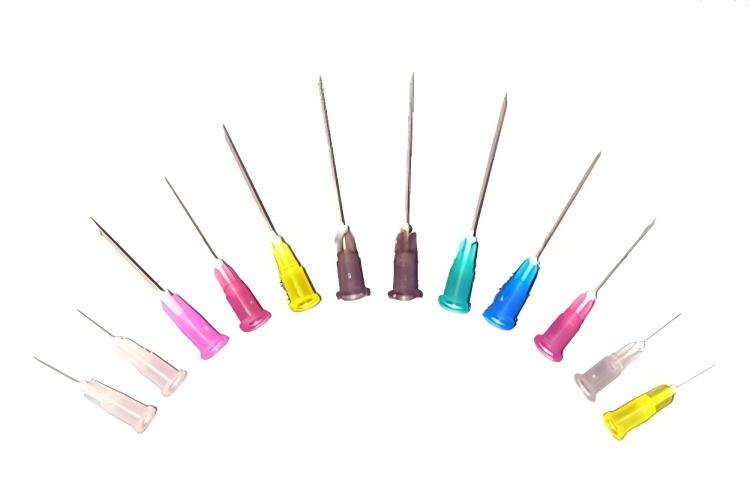
The 29g insulin syringe represents where needle technology starts prioritizing comfort significantly. At about 0.33mm, this needle is noticeably thinner.
Advantages:
- Significantly reduced injection pain
- Still maintains reasonable flow rate
- Good for daily multiple injections
- Reduced tissue trauma
Ideal users:
- Patients injecting 3-4 times daily
- People with needle anxiety
- Children (with appropriate adult supervision)
- Anyone prioritizing comfort
Trade-off: Slightly slower insulin delivery, but most patients don’t notice unless injecting large volumes
30G Insulin Syringes: Premium Comfort
The comfort sweet spot
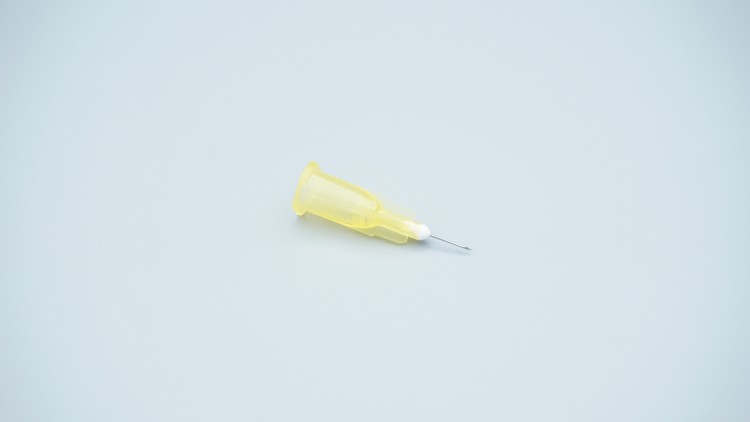
A 30g insulin syringe is where many patients find their ideal balance. At 0.3mm diameter, this needle provides excellent comfort while still performing reliably.
Why patients love 30G:
- Minimal insertion pain
- Greatly reduced needle anxiety
- Suitable for lean patients with less subcutaneous fat
- Precise control during injection
Best applications:
- Patients committed to long-term insulin therapy
- Those with previous needle trauma or anxiety
- Multiple daily injection regimens
- Rotating injection sites (arms, abdomen, thighs)
Professional tip: This gauge works beautifully with 6mm needles for a virtually painless experience
31G Insulin Syringes: Ultra-Fine Comfort
State-of-the-art needle technology
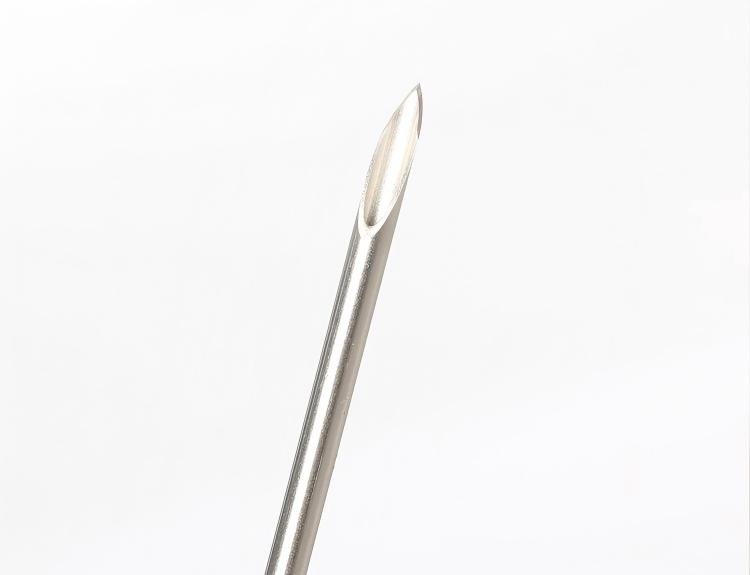
The 31g insulin syringe represents the pinnacle of comfort engineering for standard insulin syringes. At approximately 0.25mm, this needle is incredibly thin.
The 31G experience:
- Many patients describe injections as “barely feeling anything”
- Significantly reduced tissue trauma
- Faster healing of injection sites
- Less bruising and bleeding
Perfect for:
- Patients with severe needle phobia
- Children and adolescents
- People with sensitive skin
- Anyone injecting in visible areas (arms, legs)
Important considerations:
- Slower insulin flow (takes a few extra seconds)
- Requires steady hand during injection
- May bend if technique is too aggressive
- Slightly more expensive than thicker gauges
Real patient story:
“I dreaded my insulin injections with 28G needles. When my diabetes educator suggested trying 31g insulin syringes, I was skeptical. The first injection with 31G, I kept waiting for the pain… and it never came. It changed my entire relationship with my diabetes care.”
32G Insulin Syringes: The Ultra-Thin Option
Pushing comfort boundaries
The 32g insulin syringe is among the thinnest available, at about 0.23mm diameter. These are specialty items, not as commonly available as other gauges.
Who benefits most:
- Extremely needle-sensitive patients
- Very young children
- Patients with anxiety disorders
- Those with previous trauma related to injections
Realistic expectations:
- Noticeably slower injection time
- Requires patient technique
- More expensive
- May not be covered by all insurance plans
Availability: Less common; may need to be special-ordered through pharmacy
Needle Length: The Other Important Dimension
Short Needles (6mm / 1/4 inch)
Modern recommendation
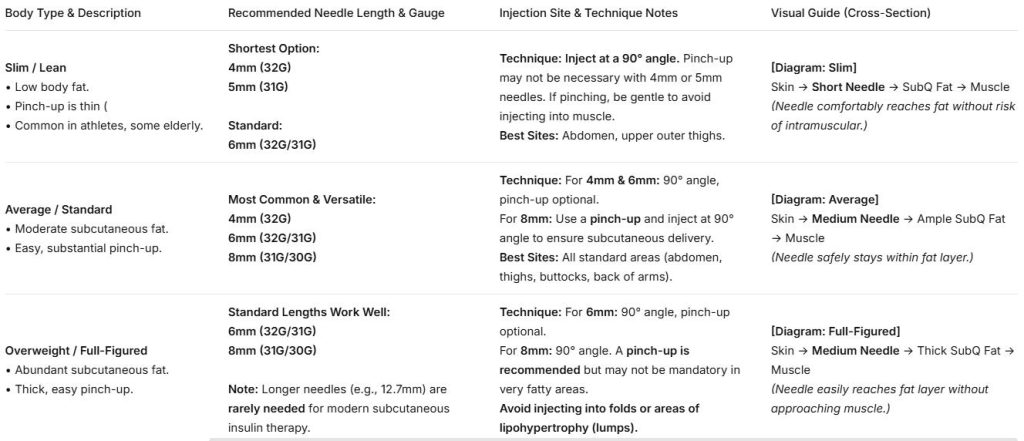
Research shows that 6mm needles work effectively for most patients, including those with higher BMI. They’re now the recommended starting length.
Benefits:
- Less intimidating
- Reduced risk of intramuscular injection
- More comfortable
- Suitable for all body types when used with proper technique
Best technique: Inject straight in (90-degree angle) for most people; lean patients may pinch skin
Medium Needles (8mm / 5/16 inch)
The traditional standard
8mm needles have been the workhorse length for decades and remain popular.
When to choose 8mm:
- Patient preference (familiarity)
- Higher body fat percentage
- Injecting without skin pinching
- Scar tissue at injection sites
Technique tip: May require 45-degree angle for lean patients
Long Needles (12.7mm / 1/2 inch)
Specialized situations
Longer needles are less common now but still have specific uses.
Appropriate for:
- Significantly higher BMI
- Large muscle mass athletes
- Areas with substantial subcutaneous fat
- Patient preference after consultation
Caution: Higher risk of intramuscular injection; proper technique essential
The Latex Question: Are Insulin Syringes Safe for Latex Allergies?
Understanding Latex in Medical Devices
If you have a latex allergy, it’s natural to worry about medical supplies. Here’s what you need to know about modern insulin syringes and latex.
The good news:
Nearly all modern insulin syringes are latex-free. Manufacturing has evolved significantly, and latex is no longer necessary for quality syringe production.
What might contain latex:
- Older syringe models (pre-2000s)
- Some imported syringes from certain countries
- The rubber plunger tip (historically)
- Packaging materials (occasionally)
What’s used instead: Modern syringes use synthetic elastomers such as:
- Synthetic rubber compounds
- Silicone-based materials
- Thermoplastic elastomers (TPE)
- Styrenic block copolymers
How to Verify Latex-Free Status
Always check:
- Product packaging – should state “latex-free” clearly
- Manufacturer specifications
- Your pharmacist
- The package insert
Our commitment:
All Kohope insulin syringes are manufactured completely latex-free. From the barrel to the plunger tip to the needle hub, we use only synthetic materials that are safe for latex-allergic patients.
If you have latex sensitivity:
- Inform your healthcare team
- Keep documentation of your allergy visible
- Verify latex-free status with each new prescription
- Consider wearing a medical alert bracelet
Choosing Your Perfect Insulin Syringe: A Decision Framework
Step 1: Determine Your Dose Range
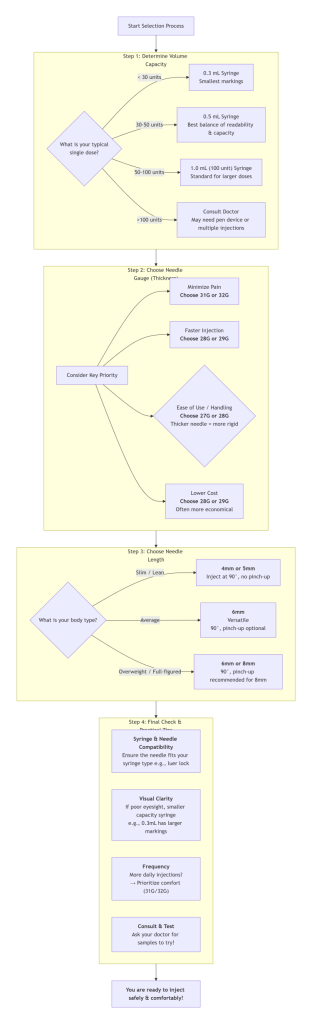
Calculate your maximum single dose:
- Less than 30 units → Consider 0.3ml insulin syringe
- 30-50 units → 0.5ml insulin syringe is ideal
- 50-100 units → Use 1ml insulin syringe
- Over 100 units → Consult your doctor; insulin pens might be better
Step 2: Consider Your Comfort Priorities
Rate these factors (1-10):
- Pain sensitivity: ___
- Injection speed preference: ___
- Budget constraints: ___
- Visual clarity needed: ___
If pain sensitivity scores highest: Choose 30G or 31G needles
If injection speed matters most: Choose 27G or 28G needles
If visual clarity is crucial: Choose smaller capacity syringe (larger markings)
Step 3: Factor in Your Injection Frequency
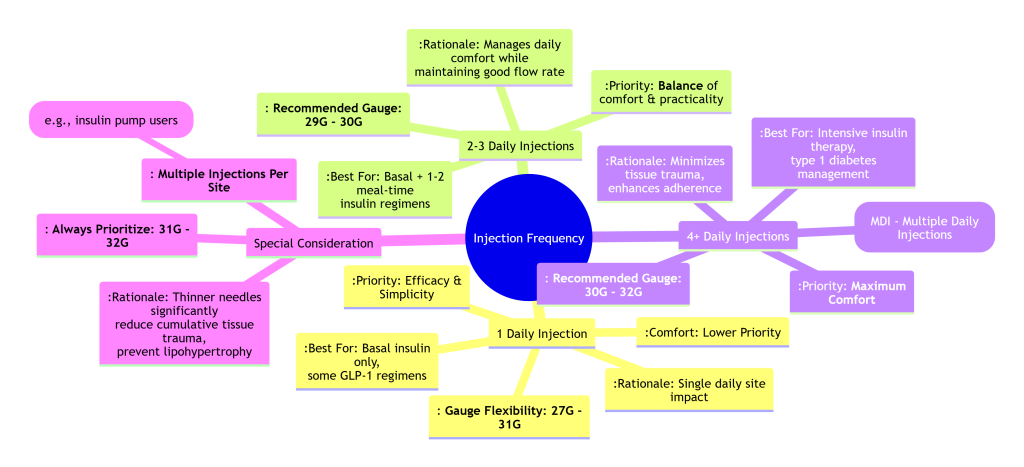
Once daily: Comfort matters less; any gauge works
2-3 times daily: Consider 29G-30G for balance
4+ times daily: Prioritize 30G-31G for comfort
Multiple injections per site: Thinner needles reduce cumulative trauma
Step 4: Consider Your Physical Characteristics
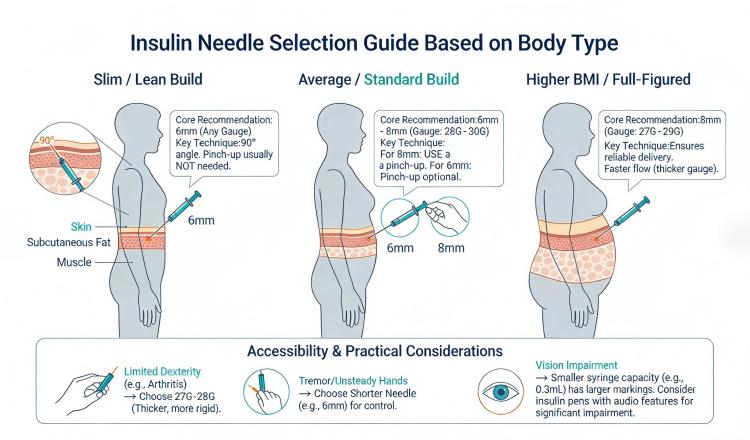
Body composition:
- Lean build → 6mm needle, any gauge
- Average build → 6-8mm needle, 28-30G
- Higher BMI → 8mm needle, 27-29G (faster flow)
Hand dexterity:
- Arthritis or limited dexterity → Thicker gauge (27-28G)
- Tremor or unsteady hands → Shorter needle (6mm)
- Full dexterity → Any gauge works
Vision:
- Excellent vision → Any syringe capacity
- Moderate impairment → Smaller capacity (larger markings)
- Significant impairment → Consider insulin pens with audio features
Step 5: Try Before Committing
Smart strategy:
Ask your diabetes educator or doctor for samples of different gauges. Many clinics have sample syringes you can try at your appointment to feel the difference.
What to test:
- Comfort during insertion
- Ease of pushing plunger
- Ability to read markings
- Overall handling confidence
Special Considerations
For Parents of Children with Diabetes
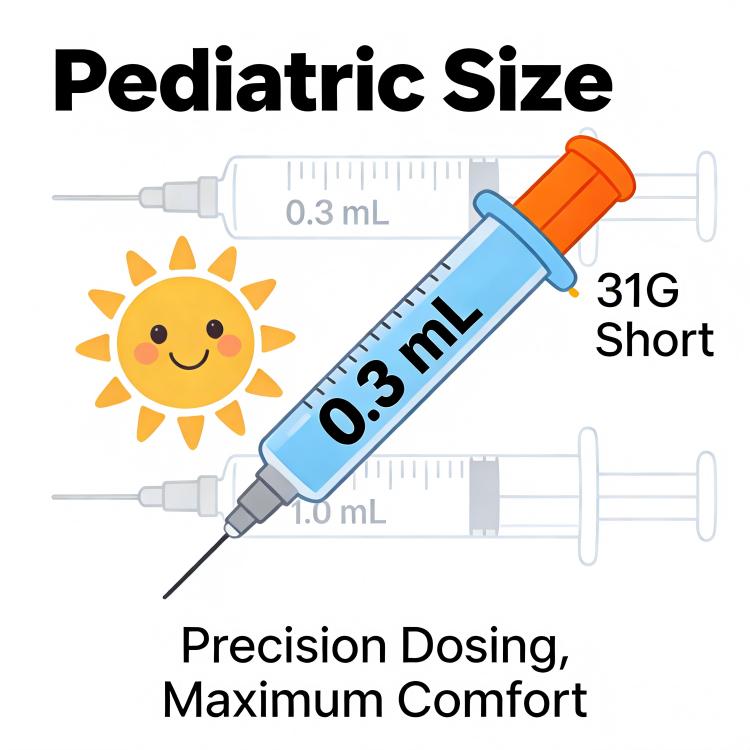
Choosing for your child:
- Start with 0.3ml or 0.5ml insulin syringes (easier to read small doses)
- Use 31G or 32G needles (minimize discomfort)
- Choose 6mm needle length (less intimidating)
- Let your child choose needle cap colors if available (sense of control)
Teaching tip: Practice with saline injections on an orange or foam pad together before the first real injection
For Elderly Patients
Key considerations:
- Vision: Choose capacity that makes markings easy to read
- Arthritis: Slightly thicker needles (28G) may be easier to inject
- Memory: Consistent syringe type reduces confusion
- Safety: Pre-filled syringes by caregiver if appropriate
For Active Lifestyles and Athletes
Special needs:
- Higher muscle mass may need 8mm needles
- Multiple daily injections benefit from 30-31G comfort
- Consider injection site rotation for scarring prevention
- Waterproof packaging for travel
For Budget-Conscious Patients
Cost-saving strategies:
- Generic syringes work as well as name brands
- Larger quantity purchases often discount per unit
- Some manufacturers offer patient assistance programs
- Thinner needles (31G) cost more but may be worth it for comfort
Don’t compromise on:
- Sterility (never reuse syringes)
- Proper gauge for your needs
- Quality manufacturing standards
Common Mistakes to Avoid
Mistake #1: Choosing Based on Needle Gauge Alone
The problem: Focusing only on getting the thinnest needle without considering injection technique, dose size, or insulin type.
Better approach: Balance comfort with functionality. A 31G needle with poor technique hurts more than a 28G needle with good technique.
Mistake #2: Using Syringes Too Large for Your Dose
Why it matters: Measuring 8 units in a 100-unit syringe is like measuring a teaspoon of liquid in a 2-cup measuring cup – accuracy suffers.
Rule of thumb: Your typical dose should fill at least 1/3 of the syringe barrel.
Mistake #3: Ignoring Needle Length
Common error: Patients focus on gauge (thickness) but forget about length, which affects injection depth and comfort.
Remember: A 31G needle that’s 12.7mm long may be less comfortable than a 29G needle that’s 6mm long.
Mistake #4: Not Rotating Injection Sites
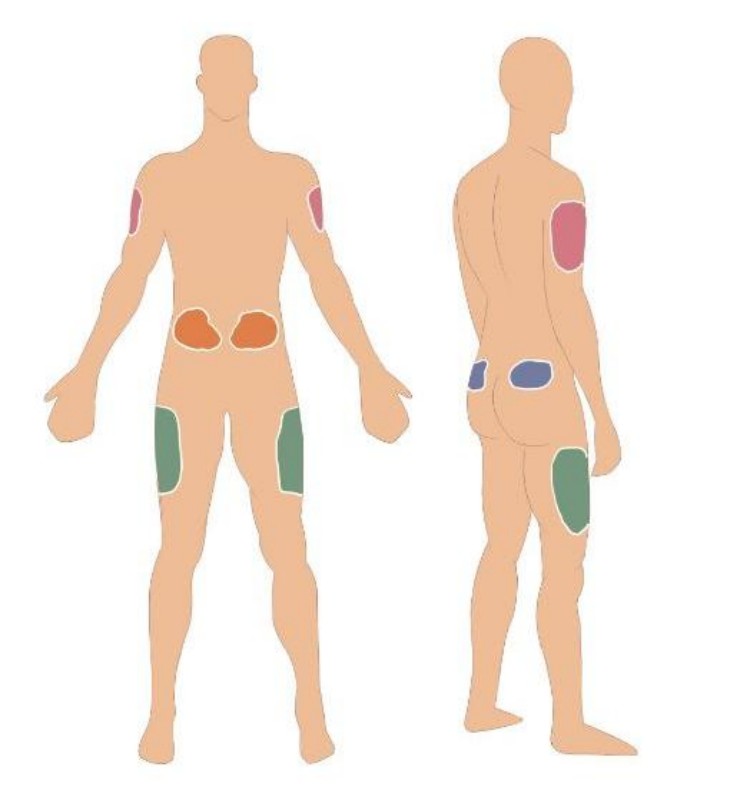
The issue: Using the same syringe configuration at the same site repeatedly causes lipohypertrophy (fatty lumps under skin).
Solution: Even with the best insulin syringe, rotate sites: abdomen, thighs, upper arms, buttocks.
Mistake #5: Reusing Syringes
Never reuse insulin syringes. Even if it’s your own insulin and syringe:
- Needles dull after one use (increases pain)
- Contamination risk increases
- Insulin crystallization can clog the needle
- Proper disposal prevents accidental needle sticks
Proper Injection Technique: Making the Most of Your Syringe Choice
Before Injection
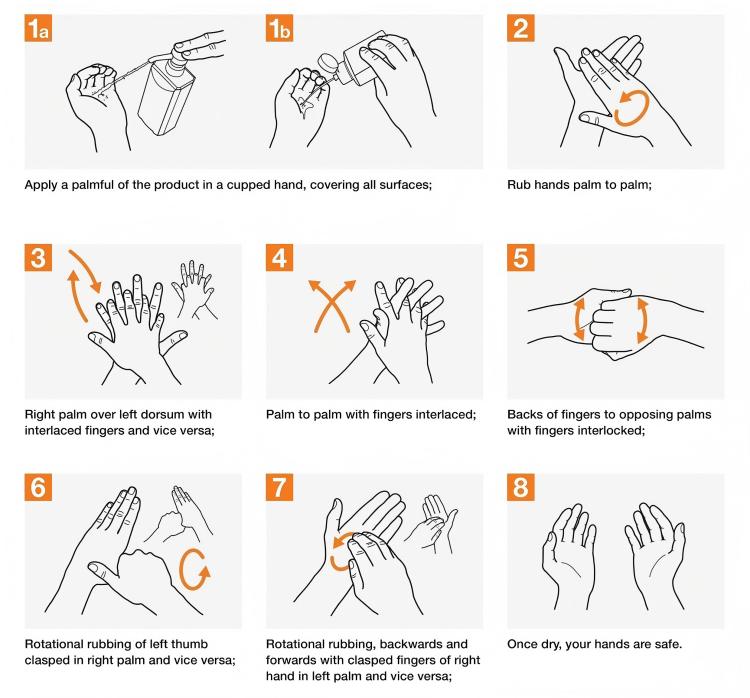
- Wash hands thoroughly
- Check insulin appearance (should be clear or uniformly cloudy)
- Warm insulin to room temperature if refrigerated
- Inspect syringe for damage or contamination
- Choose and clean injection site with alcohol swab
Drawing Insulin
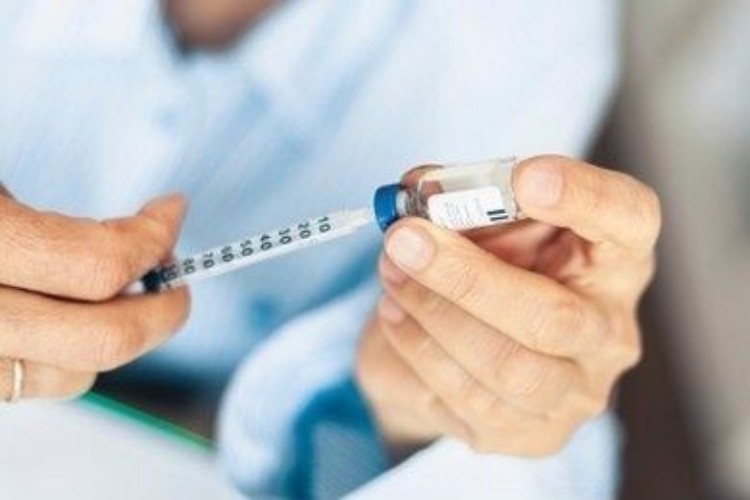
- Roll cloudy insulin gently (don’t shake)
- Draw air equal to insulin dose into syringe
- Inject air into insulin vial
- Invert vial and draw insulin
- Check for air bubbles (tap and expel if present)
- Verify correct dose
Injection Steps
- Pinch skin if needed (6mm needles usually don’t require this)
- Insert needle quickly at appropriate angle
- 90 degrees for most people with 6mm needles
- 45 degrees for very lean people or longer needles
- Push plunger smoothly
- Count to 5-10 before withdrawing (prevents insulin leakage)
- Withdraw at same angle inserted
- Don’t rub injection site
After Injection
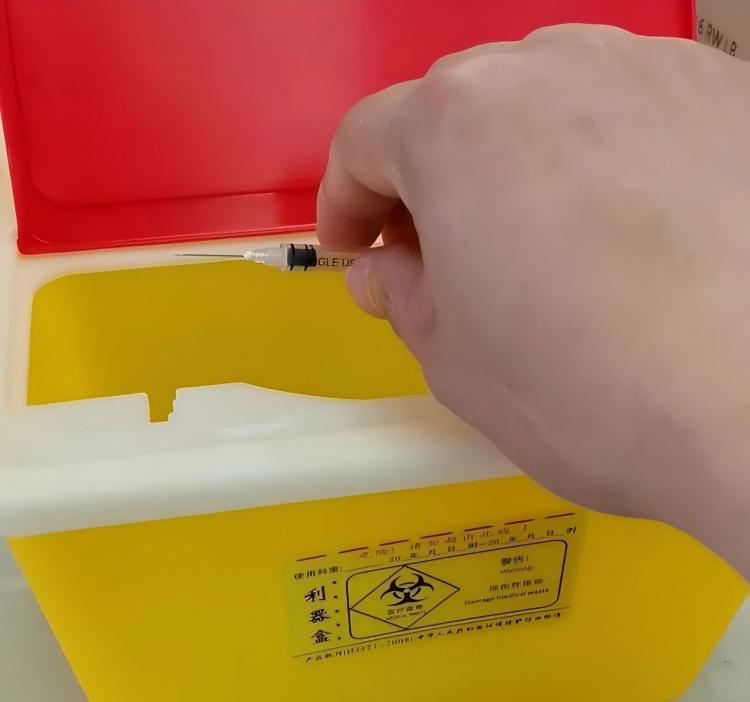
- Dispose in sharps container immediately
- Record dose, time, and site in your diabetes log
- Store insulin properly
- Monitor blood sugar as prescribed
Frequently Asked Questions
Q: Can I switch between syringe sizes safely?
A: Yes, but be careful! The markings differ. A 0.3ml insulin syringe might have half-unit marks, while a 1ml insulin syringe has 2-unit increments. Always verify you’re reading the correct scale.
Q: Why does my pharmacy sometimes give me different syringes?
A: Supply issues or insurance formularies may dictate what’s available. Always verify the capacity and markings match what you expect before using.
Q: Do I really need to change needle gauge?
A: Not necessarily. If your current gauge works well, stick with it. But if you’re experiencing pain, anxiety, or bruising, trying a thinner gauge might help significantly.
Q: Are insulin pens better than syringes?
A: It depends. Pens are more convenient and discreet but may cost more. Syringes offer more flexibility in dosing and are essential for mixing insulins. Discuss with your healthcare team.
Q: How long can I keep an opened box of syringes?
A: Unopened syringes don’t expire if stored properly. Once opened, keep them clean and dry. Follow the manufacturer’s guidance, but most remain sterile for years if packaging is intact.
Q: What if my insurance only covers specific syringes?
A: Contact your insurance provider about medical necessity appeals if you need a specific gauge or size. Your doctor can provide documentation if clinical need exists.
Q: Can I travel internationally with insulin syringes?
A: Yes, with proper documentation. Carry:
- Prescription or doctor’s letter
- Original pharmacy labels
- Insulin in original packaging
- Syringes in original box with labels
Check specific country regulations before traveling.
The Bottom Line: Your Insulin Syringe Journey
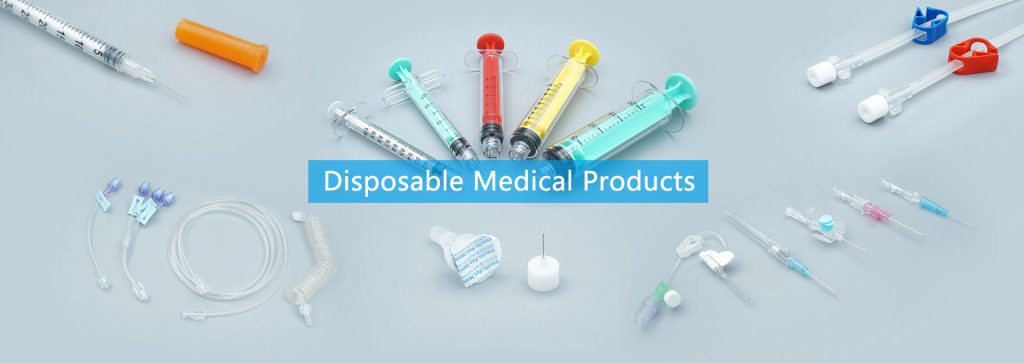
Choosing the right insulin syringe isn’t about finding the “best” option – it’s about finding your best option. What works perfectly for one person might not suit another.
Remember these key principles:
- Syringe capacity should match your dose range – using the right size improves accuracy
- Needle gauge affects comfort – thinner is usually more comfortable but slower
- Needle length matters – modern 6mm needles work for most people
- All quality syringes are latex-free – verify if you have concerns
- Technique matters more than equipment – even the best syringe needs proper use
Your action plan:
- Calculate your typical insulin dose range
- Assess your comfort priorities
- Consult your healthcare team about options
- Try samples if possible
- Start with a compromise (like 29G or 30G) and adjust
- Give each option a fair trial (at least 2-3 days)
- Choose what works best for your lifestyle
Whether you need a 0.3 ml insulin syringe for your child’s small doses, prefer the comfort of a 31g insulin syringe, or require a 1ml insulin syringe for higher insulin needs, understanding your options empowers you to make informed decisions about your diabetes care.
Remember: Managing diabetes is a marathon, not a sprint. Finding the right tools – including the perfect insulin syringe – makes the journey more comfortable and sustainable. Don’t hesitate to ask questions, try different options, and advocate for what works best for you.
Have questions about choosing the right insulin syringe? Consult with your diabetes educator or healthcare provider. They can provide personalized recommendations based on your specific needs and can often provide samples for you to try.
Disclaimer: This guide provides educational information only and is not a substitute for professional medical advice. Always follow your healthcare provider’s recommendations for insulin therapy and syringe selection.