A Strategic Framework for European Buyers: Cost Analysis, Regulatory Pathways & Quality Assurance
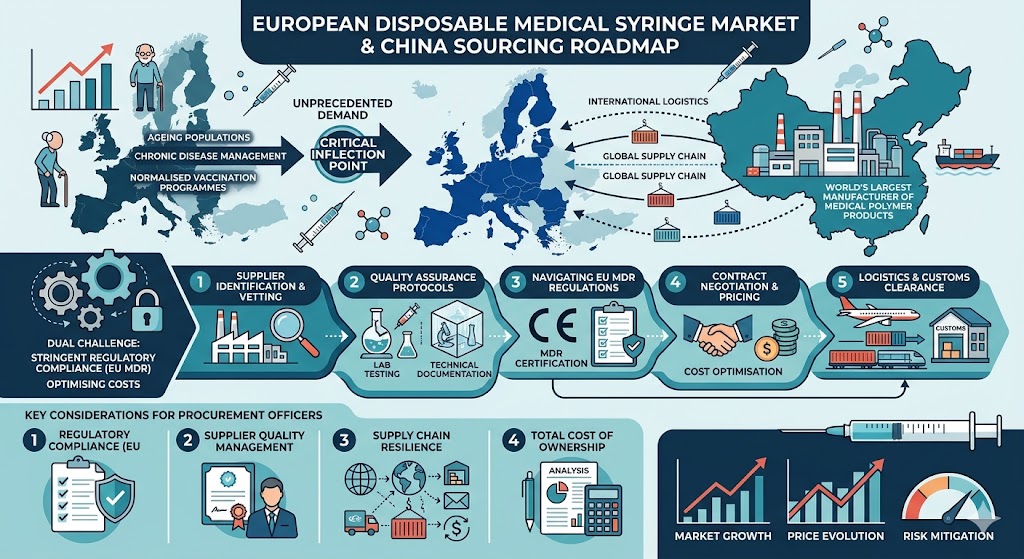
The European disposable medical syringe market has reached a critical inflection point. With ageing populations, chronic disease management, and normalised vaccination programmes driving unprecedented demand, procurement professionals face a dual challenge: maintaining stringent regulatory compliance whilst optimising costs in an increasingly competitive landscape.
This comprehensive guide provides European healthcare procurement officers, medical device distributors, and institutional buyers with a detailed roadmap for sourcing disposable syringes from China—the world’s largest manufacturer of medical polymer products—whilst navigating the complexities of EU MDR regulations, international logistics, and quality assurance protocols.
Key Takeaways:
- EU medical syringe market exceeds €3.7 billion annually, with China-sourced products offering 30-50% cost advantages
- MDR compliance is non-negotiable: understanding Notified Body certifications can prevent costly rejections
- Total landed cost analysis reveals hidden expenses beyond ex-factory pricing
- Strategic supplier vetting frameworks reduce quality disputes and regulatory risks
Chapter 1: EU Medical Syringe Market Overview—Why China Remains the Strategic Sourcing Hub
1.1 Market Drivers & Demand Fundamentals
The European medical syringe market continues its robust growth trajectory, propelled by several irreversible demographic and epidemiological trends:
Demographic Imperatives:
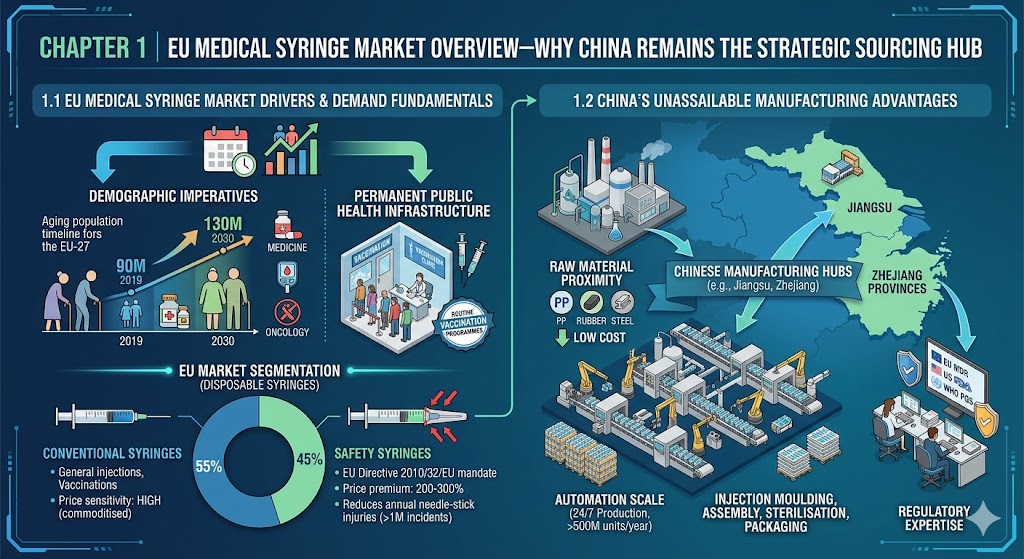
- The EU-27’s population aged 65+ will reach 130 million by 2030 (up from 90 million in 2019), intensifying demand for injectable therapies for chronic conditions including diabetes, oncology treatments, and anticoagulation management
- Routine vaccination programmes have become permanently embedded in public health infrastructure following pandemic preparedness reforms
Market Segmentation: The EU disposable syringe market bifurcates into two primary categories:
- Conventional Syringes (Standard safety profile)
- Market share: ~55%
- Applications: General injections, vaccinations, blood sampling
- Price sensitivity: High (commoditised product category)
- Safety Syringes (Needle-stick injury prevention mechanisms)
- Market share: ~45% and growing
- Regulatory driver: EU Directive 2010/32/EU mandates needle-stick prevention
- Price premium: 200-300% over conventional syringes
- Annual needle-stick injuries in EU healthcare: >1 million incidents
1.2 China’s Unassailable Manufacturing Advantages
Industrial Concentration: China’s medical device manufacturing clusters—particularly in Jiangsu Province (Changzhou, Yangzhou) and Zhejiang Province—have achieved vertical integration that European manufacturers cannot replicate cost-effectively:
- Raw Material Proximity: Direct access to medical-grade polypropylene (PP), natural rubber compounds, and stainless steel at significantly lower input costs
- Automation Scale: Industry-leading factories operate 24/7 production lines with injection moulding, assembly, sterilisation, and packaging capacities exceeding 500 million units annually
- Regulatory Expertise: Tier-1 Chinese manufacturers maintain dedicated regulatory affairs teams for EU MDR, US FDA, and WHO PQS compliance
Comparative Cost Analysis (2026 Benchmarks):
| Syringe Type | EU Domestic Manufacturing | China FOB Price | Cost Advantage |
|---|---|---|---|
| 3ml Luer Slip (conventional) | €0.08-0.12 | €0.02-0.04 | 60-75% |
| 5ml Luer Lock (conventional) | €0.10-0.15 | €0.03-0.05 | 65-70% |
| 3ml Safety (retractable) | €0.25-0.35 | €0.08-0.14 | 55-68% |
Note: Prices exclude VAT, logistics, and import duties. FOB Shanghai/Ningbo basis.
1.3 Strategic Considerations for European Buyers
When China Sourcing Makes Commercial Sense:
- ✅ Annual procurement volumes exceeding 500,000 units (economies of scale justify logistics complexity)
- ✅ Non-critical supply chains with 60-90 day lead time tolerance
- ✅ Price-sensitive tenders where 20%+ cost reduction determines contract awards
- ✅ Private label/OEM requirements with customised specifications
When Domestic/European Sourcing Remains Preferable:
- ❌ Emergency stockpiling with <30 day delivery requirements
- ❌ Highly specialised syringes with proprietary technologies (e.g., pre-filled biologics)
- ❌ Ultra-low volume requirements (<100,000 units) where MOQs create inventory risks
- ❌ Extreme regulatory scrutiny environments requiring 100% traceability to European QMS
Chapter 2: MDR Compliance Essentials—Non-Negotiable Requirements for EU Syringe Importers
2.1 Understanding the MDR Revolution: From MDD to Regulation (EU) 2017/745
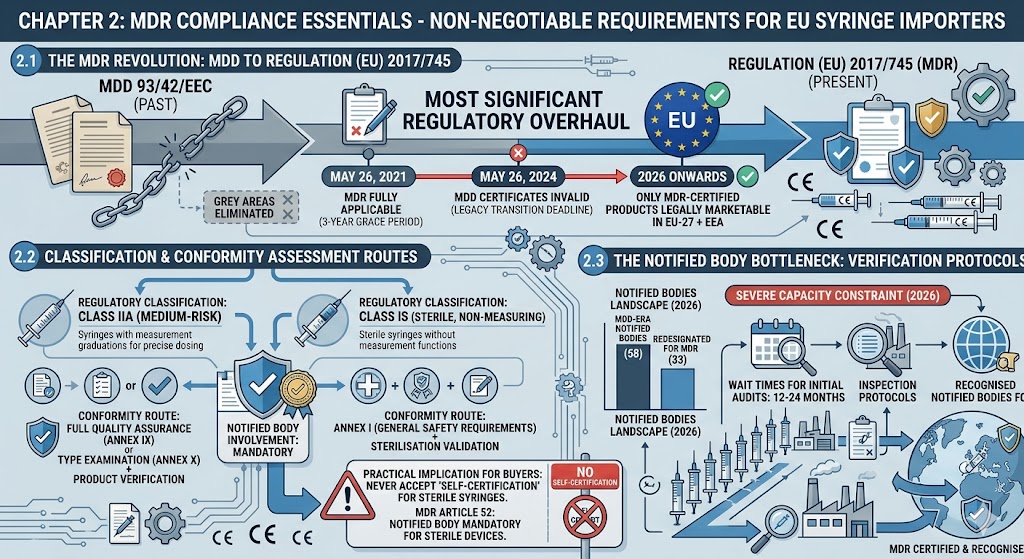
The transition from the Medical Device Directive (MDD 93/42/EEC) to the Medical Device Regulation (MDR) represents the most significant regulatory overhaul in European medical device history. For disposable syringe procurement, this transition eliminated numerous grey areas that previously allowed non-compliant products to enter EU markets.
Critical Timeline:
- 26 May 2021: MDR became fully applicable (3-year grace period from publication)
- 26 May 2024: MDD certificates became invalid (legacy transition deadline)
- 2026 onwards: Only MDR-certified products legally marketable in EU-27 + EEA
2.2 Classification & Conformity Assessment Routes
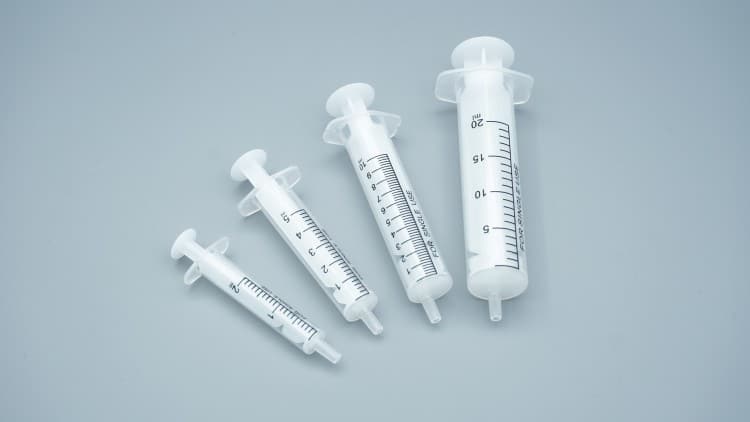
Regulatory Classification: Disposable syringes fall under Class IIa (medium-risk) or Class Is (sterile, non-measuring) depending on configuration:
- Class IIa: Syringes with measurement graduations intended for precise dosing
- Conformity route: Full Quality Assurance (Annex IX) or Type Examination (Annex X) + Product Verification
- Notified Body involvement: Mandatory
- Class Is: Sterile syringes without measurement functions
- Conformity route: Annex I (General Safety Requirements) + Sterilisation validation
- Notified Body involvement: Mandatory for sterile aspects
Practical Implication for Buyers: Never accept supplier claims of “self-certification” for sterile syringes. MDR Article 52 unambiguously requires Notified Body involvement for all sterile medical devices.
2.3 The Notified Body Bottleneck: Verification Protocols
Current Notified Body Landscape (2026): The MDR transition created a severe capacity constraint. Of 58 MDD-era Notified Bodies, only 33 have successfully redesignated for MDR compliance. Wait times for initial audits range from 12-24 months.
Recognised Notified Bodies for Chinese Manufacturers: When vetting Chinese suppliers, verify certifications from these established bodies:
| Notified Body | ID Number | Headquarters | Typical Audit Cycle |
|---|---|---|---|
| TÜV SÜD Product Service | 0123 | Munich, Germany | 18-24 months |
| TÜV Rheinland | 0197 | Cologne, Germany | 16-20 months |
| BSI Group (British Standards Institution) | 0086 | London, UK | 20-26 months |
| SGS Belgium NV | 0120 | Antwerp, Belgium | 18-22 months |
| DEKRA Certification | 0124 | Stuttgart, Germany | 16-24 months |
Red Flags—Invalid Certifications:
- ⚠️ Certificates issued by bodies without MDR designation (check NANDO database: https://ec.europa.eu/growth/tools-databases/nando/)
- ⚠️ MDD certificates with expiry dates post-May 2024 (legally invalid)
- ⚠️ “CE certificates” from testing laboratories (e.g., Intertek, SGS testing divisions)—these entities perform testing but cannot issue CE certificates
- ⚠️ Certificates lacking the 4-digit Notified Body identification number beside the CE mark
2.4 Essential Quality Management System Standards
ISO 13485:2016—The Foundation: This medical device quality management system standard is prerequisite for MDR compliance. Verify that Chinese suppliers maintain:
- Current ISO 13485 certificates (maximum 3-year validity, annual surveillance audits)
- Scope statements explicitly covering “sterile disposable syringes” (generic medical device scopes insufficient)
- Certification by accredited bodies (ANAB, UKAS, DAkkS, RvA, etc.)
Product-Specific Standards: The following ISO standards form the technical conformity baseline:
- ISO 7886-1:2017 — Sterile hypodermic syringes for single use (conventional syringes)
- ISO 7886-4:2019 — Syringes with re-use prevention feature (safety syringes)
- ISO 11040-4:2015 — Pre-filled syringes (if applicable)
- ISO 11608-1 — Needle-based injection systems (for specialized applications)
Testing Protocols to Verify: Request test reports demonstrating compliance with:
- Needle penetration force (ISO 7864)
- Luer fitting compatibility (ISO 80369-7)
- Ethylene oxide (EO) sterilisation validation (ISO 11135)
- Biocompatibility testing (ISO 10993 series, minimum parts 1, 5, 10, 11)
2.5 EC Authorised Representative & EUDAMED Registration
EC Representative Mandate: Non-EU manufacturers must appoint an EC Authorised Representative (EC Rep) established within the EU-27. This representative assumes legal responsibility for MDR compliance and serves as the liaison with competent authorities.
EC Rep Due Diligence:
- Verify the EC Rep’s EUDAMED registration (publicly searchable via https://ec.europa.eu/tools/eudamed)
- Confirm the EC Rep maintains Professional Indemnity Insurance (minimum €5 million coverage recommended)
- Review the contractual mandate to ensure it covers post-market surveillance obligations
EUDAMED Actor Registration: As of 2025, manufacturers and EC Reps must register in EUDAMED (European Database on Medical Devices). Before placing orders, confirm:
- Manufacturer’s Single Registration Number (SRN-M)
- EC Rep’s Single Registration Number (SRN-R)
- Device’s Basic UDI-DI (Unique Device Identifier—Device Identifier)
Verification Checkpoint: Request screenshots or direct EUDAMED links proving registration. This prevents scenarios where goods arrive at EU ports but cannot clear customs due to missing EUDAMED entries.
Chapter 3: Total Cost Breakdown—40ft Container Syringe Import Cost Analysis
Understanding the true landed cost of Chinese-sourced syringes requires granular analysis across the entire supply chain. This chapter deconstructs costs using a standard 40ft High Cube (40HQ) container as the benchmark unit.
3.1 Container Loading Capacity: Volume vs. Weight Constraints
Physical Specifications:
- 40HQ Internal Dimensions: 12.03m (L) × 2.35m (W) × 2.69m (H)
- Volumetric Capacity: ~76 cubic metres
- Maximum Gross Weight: 26,500 kg (port-dependent; some EU ports restrict to 24,000 kg)
Loading Calculations for Standard Syringes:
Disposable syringes are volume-constrained cargo (low density, high volume). Loading efficiency depends critically on packaging configuration:
| Syringe Type | Units per Carton | Carton Dimensions (cm) | Cartons per 40HQ | Total Units |
|---|---|---|---|---|
| 1ml Luer Slip (blister pack) | 100 | 45×30×25 | 1,800 | 180,000 |
| 3ml Luer Slip (blister pack) | 100 | 50×35×30 | 1,400 | 140,000 |
| 5ml Luer Lock (blister pack) | 100 | 55×40×32 | 1,200 | 120,000 |
| 3ml Safety (blister + shield) | 100 | 58×42×35 | 1,000 | 100,000 |
| 3ml Luer Slip (PE bag bulk) | 500 | 60×45×40 | 950 | 475,000 |
Assumptions: Blister packaging for single-unit sterility; PE bag bulk packaging for cost-sensitive tenders.
Key Insight: Switching from blister to bulk PE bag packaging can increase unit capacity by 240-300%, dramatically reducing per-unit shipping costs, but may not meet certain hospital sterilisation protocols.
3.2 Ex-Works (EXW) Pricing: Factory Gate Costs
Cost Structure Breakdown (Representative 3ml Luer Slip Syringe):
| Component | Cost per Unit (USD) | Percentage of Total |
|---|---|---|
| Medical-grade PP resin (barrel, plunger) | $0.0080 | 28% |
| Natural rubber gasket (piston seal) | $0.0045 | 16% |
| Stainless steel needle (21G×1.5″) | $0.0065 | 23% |
| Silicone lubricant (internal coating) | $0.0008 | 3% |
| Injection moulding & assembly labour | $0.0035 | 12% |
| EO sterilisation & validation | $0.0025 | 9% |
| Blister packaging materials | $0.0015 | 5% |
| Quality control & testing | $0.0007 | 2% |
| Total EXW Price | $0.0280 | 100% |
Volume-Based Pricing Tiers (2026 Market Rates):
Chinese manufacturers typically operate on tiered pricing models:
- <100,000 units: $0.035-0.040 (small batch premium)
- 100,000-500,000 units: $0.028-0.032 (standard commercial pricing)
- 500,000-1,000,000 units: $0.024-0.028 (volume discount tier 1)
- >1,000,000 units: $0.020-0.024 (volume discount tier 2, annual contract basis)
Customisation Premiums:
- Private labelling/branding: +$0.002-0.005 per unit
- Non-standard needle gauges (e.g., 27G, 30G): +$0.003-0.008
- Colour-coded plungers (dosage differentiation): +$0.001-0.002
- Multi-language printing (beyond English): +$0.0005 per additional language
3.3 Domestic China Logistics: Factory to Port
Inland Transportation (Factory to Shanghai/Ningbo Port):
Most syringe manufacturers cluster in Jiangsu Province, approximately 200-300 km from major ports.
- Trucking Cost (40HQ): $280-350
- Breakdown: Tractor fee ($180), fuel surcharge ($60-80), highway tolls ($40-70), driver fee ($20)
- Container Handling at Origin: $45-60
- Customs Declaration & Inspection: $120-180
- Medical device export license verification
- Commodity inspection certificate (CIQ)—mandatory for medical devices
Export Compliance Documentation: Chinese customs require the following for medical device exports:
- Medical Device Export License (issued by China NMPA if product domestically registered)
- Commodity Inspection Certificate (CIQ)—quality verification by China Customs
- Commercial Invoice, Packing List, Contract
- Certificate of Origin (preferential tariff eligibility if EU-China trade agreement applies)
Total Domestic China Costs: $445-590 per 40HQ container
3.4 International Ocean Freight: China to EU Ports
Freight Rate Volatility (2024-2026 Trends):
Ocean freight rates remain influenced by post-pandemic normalisation, geopolitical disruptions, and fuel costs. As of Q2 2026:
| Route | Port Pair | 40HQ Rate Range (USD) | Transit Time |
|---|---|---|---|
| North Europe | Shanghai → Rotterdam | $1,800-2,400 | 28-35 days |
| North Europe | Ningbo → Hamburg | $1,850-2,500 | 30-38 days |
| Mediterranean | Shanghai → Piraeus | $1,600-2,200 | 25-32 days |
| Mediterranean | Ningbo → Genoa | $1,700-2,300 | 28-34 days |
| Adriatic | Shanghai → Trieste | $1,750-2,350 | 30-36 days |
Rates subject to Peak Season Surcharges (PSS) during Q3-Q4 (+$300-600), and Bunker Adjustment Factor (BAF) fluctuations.
Incoterms Selection Strategy:
- FOB (Free On Board): Buyer assumes risk/cost from vessel loading
- Advantages: Greater control over carrier selection, potential for lower freight rates through own forwarder
- Disadvantages: Requires established relationships with freight forwarders, currency risk on freight payments
- CIF (Cost, Insurance, Freight): Seller delivers to destination port with insurance
- Advantages: Simplified procurement, single-point responsibility, insurance included
- Disadvantages: Typically 5-8% premium over FOB, less transparency on actual freight costs
Marine Cargo Insurance: For medical devices, recommend Institute Cargo Clauses (A)—”All Risks” coverage:
- Premium rate: 0.15-0.25% of CIF value
- Essential coverage: Physical loss/damage, water damage, container collapse
- Exclude: Wars, strikes, deliberate contamination (available as optional add-ons)
3.5 EU Import Duties, Taxes & Clearance Costs
Customs Tariff Classification:
Disposable syringes fall under HS Code 9018.31:
- Full Code (TARIC): 9018 31 10 00 (Syringes, with or without needles)
- Standard EU Duty Rate: 6.5% ad valorem
- Preferential Rates: Verify eligibility under EU-China trade agreements (currently limited; Free Trade Agreement negotiations ongoing as of 2026)
Landed Cost Calculation Example:
Assume:
- CIF Value (140,000 units @ $0.030): $4,200
- Ocean Freight: $2,000
- Insurance: $10
- Total CIF: $6,210
Duty Calculation:
- Customs Duty: $6,210 × 6.5% = $404
Value Added Tax (VAT): VAT applies on Customs Value + Duty:
- Customs Value + Duty: $6,210 + $404 = $6,614
- VAT (assuming 21% standard rate, e.g., Netherlands): $6,614 × 21% = $1,389
Port Handling & Clearance Fees (Rotterdam Example):
- Terminal Handling Charge (THC): €180-220
- Customs Clearance Agent Fee: €120-160
- Document Processing: €45-65
- Total Port Fees: €345-445 (~$375-485)
Total Import Costs: $404 + $1,389 + $430 = $2,223
Per-Unit Landed Cost: $6,210 + $2,223 = $8,433 ÷ 140,000 units = $0.0602 per syringe
3.6 Final Mile Distribution: Port to End-User
Warehousing Options:
- Bonded Warehousing (Duty deferral until domestic distribution)
- Monthly storage: €8-12 per pallet
- Advantages: Cash flow optimization, flexibility for re-export
- Requirements: Authorized warehouse operator, detailed inventory controls
- Direct Distribution to Central Hospital Pharmacy
- Road freight (40HQ Rotterdam → Munich): €850-1,100
- Delivery timeline: 3-5 days
- Minimum order: Full container loads typically required
- Disaggregation through Medical Distributor Network
- Break-bulk service: €0.002-0.004 per unit
- Advantages: Smaller order quantities, faster regional distribution
- Disadvantages: Distributor margin (15-25% markup)
Total Landed Cost Summary (140,000 units, 3ml syringes):
| Cost Category | Total Cost (USD) | Cost per Unit (USD) |
|---|---|---|
| EXW (ex-factory) | $4,200 | $0.0300 |
| China domestic logistics | $500 | $0.0036 |
| Ocean freight + insurance | $2,010 | $0.0144 |
| EU customs duty | $404 | $0.0029 |
| EU VAT (recoverable) | $1,389 | $0.0099 |
| Port clearance | $430 | $0.0031 |
| Sub-total (at port) | $8,933 | $0.0638 |
| Distribution to Munich | $950 | $0.0068 |
| Total Landed Cost | $9,883 | $0.0706 |
Benchmark Comparison:
- EU-manufactured equivalent: €0.10-0.12 ($0.108-0.130)
- Cost Savings: 42-46%
Chapter 4: Vetting Chinese Suppliers—3-Checkpoint Quality Assurance Framework
Supplier selection represents the highest-impact decision in medical device procurement. A rigorous vetting framework prevents quality failures, regulatory non-compliance, and reputational damage.
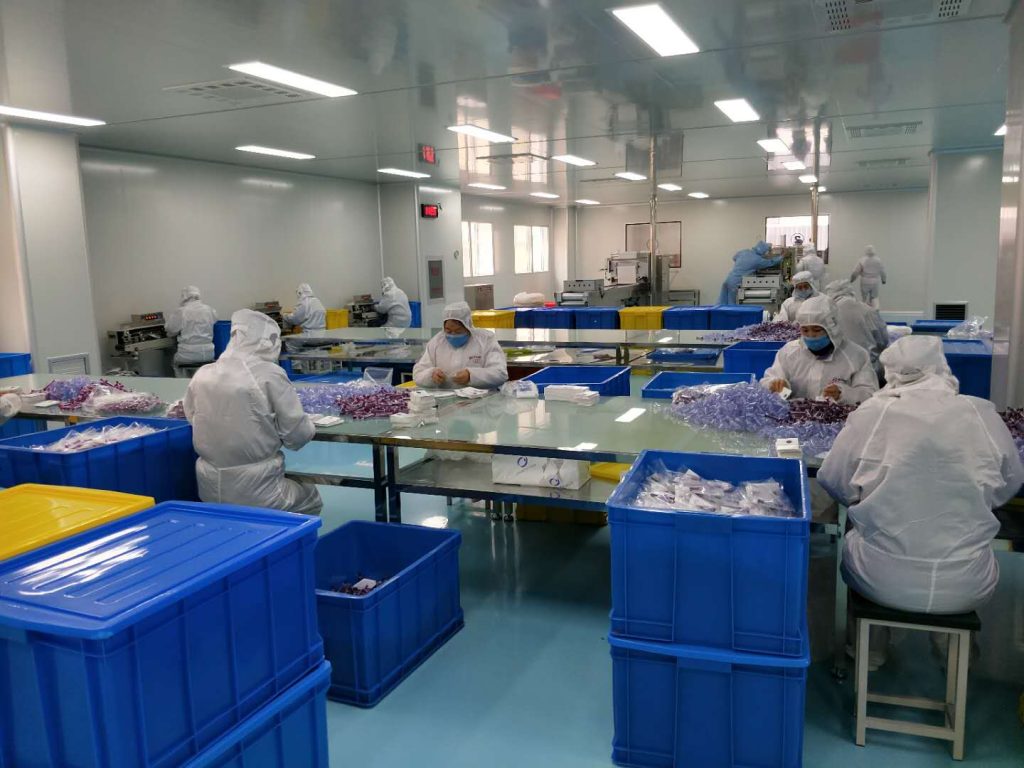
4.1 Checkpoint 1: Manufacturing Infrastructure & Cleanroom Standards
Cleanroom Classification Requirements:
For sterile medical device manufacturing, cleanroom environments are non-negotiable. ISO 14644-1 defines cleanroom classes by particulate contamination levels:
Minimum Standards for Syringe Production Areas:
| Production Stage | ISO Class Requirement | Particulate Limit (≥0.5μm) | Equivalent (old US Fed Std) |
|---|---|---|---|
| Component moulding (pre-cleaning) | ISO Class 8 | ≤3,520,000 particles/m³ | Class 100,000 |
| Assembly & needle insertion | ISO Class 7 | ≤352,000 particles/m³ | Class 10,000 |
| Final packaging (post-sterilisation) | ISO Class 8 | ≤3,520,000 particles/m³ | Class 100,000 |
On-Site Audit Checklist:
When conducting factory inspections (strongly recommended for orders >€100,000), verify:
✅ Air Handling Systems:
- HEPA filtration (H13 or H14 grade minimum)
- Documented air change rates (≥20 air changes/hour for Class 7)
- Differential pressure monitoring (10-15 Pa between adjacent zones)
- Continuous particulate monitoring with data logging
✅ Gowning & Hygiene Protocols:
- Dedicated gowning rooms with air showers
- Sterile garment protocols (coveralls, hairnets, shoe covers, gloves)
- Hand washing/disinfection stations with validation records
✅ Environmental Monitoring Programme:
- Viable (microbial) and non-viable (particle count) monitoring
- Surface contamination swab testing
- Quarterly certification by accredited third parties
Red Flags:
- ❌ Absence of visible cleanroom classification signage
- ❌ Manufacturing equipment located in general industrial spaces
- ❌ Inability to produce recent (within 6 months) environmental monitoring reports
4.2 Checkpoint 2: Production Automation & Process Controls
Automation as Quality Indicator:
High-volume, low-margin products like syringes require extensive automation to maintain consistency and cost competitiveness. Evaluate:
Critical Automated Systems:
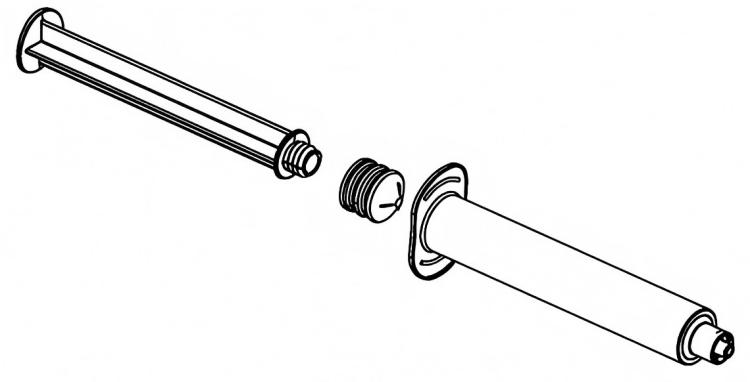
- Injection Moulding Lines:
- Multi-cavity moulds (16-32 cavities standard for barrel/plunger)
- Closed-loop temperature control (±2°C tolerance)
- Automated ejection and vision inspection systems
- Cycle time: <15 seconds for 3ml syringe components
- Automated Assembly Systems:
- Robotic plunger insertion (eliminates contamination from manual handling)
- Automated silicone lubrication application (ensures smooth plunger travel)
- Vision systems for gasket positioning verification
- Needle insertion with torque monitoring (prevents loose fittings)
- Printing & Marking:
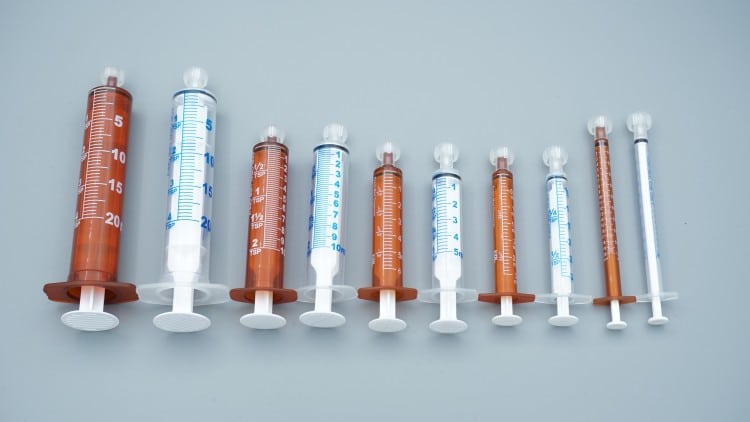
- Pad printing for graduation marks (±2% accuracy per ISO 7886-1)
- Laser etching for lot codes (permanent, tamper-proof)
- Automated print verification (OCR systems reject misprints)
- Sterilisation Validation:
- Ethylene Oxide (EO) chambers with validated cycles per ISO 11135
- Biological indicator (BI) testing (Bacillus atrophaeus spore strips)
- Parametric release protocols with continuous data recording
- Aeration chambers (removes EO residuals to <10 ppm)
Process Validation Documentation to Request:
- IQ/OQ/PQ Protocols (Installation/Operational/Performance Qualification) for critical equipment
- Process Capability Studies (Cpk ≥1.33 for critical dimensions)
- Statistical Process Control (SPC) Charts demonstrating process stability
- FMEA (Failure Mode & Effects Analysis) for high-risk assembly steps
4.3 Checkpoint 3: OEM/ODM Track Record & Reference Verification
Leveraging Established OEM Relationships:
Manufacturers supplying global medical device brands undergo rigorous third-party audits. Prioritize suppliers with verifiable OEM contracts for:
- Becton Dickinson (BD) — Market leader, most stringent QMS requirements
- B. Braun Melsungen — German precision standards
- Cardinal Health / Covidien (Medtronic) — US FDA compliance culture
- Terumo Corporation — Japanese quality systems (exceptionally low defect rates)
Reference Verification Protocol:
- Request Customer List: Minimum 3 European/North American customers with >12 months relationship
- Direct Reference Calls: Speak with Quality Assurance Managers, not sales contacts
- Audit Report Sharing: Request sanitized versions of customer audit reports (non-confidential sections)
Key Questions for References:
- “What was your most recent quality issue, and how was it resolved?”
- “Have you experienced customs/regulatory rejections? What was the root cause?”
- “What percentage of shipments require re-inspection or sorting?”
- “How does the supplier handle non-conformance reports (NCRs)?”
- “Would you classify them as ‘reactive’ or ‘proactive’ on quality matters?”
Market Reputation Indicators:
- Trade Show Presence: Regular exhibitors at MEDICA (Düsseldorf), Arab Health (Dubai), or CMEF (China) demonstrate commitment to international markets
- Regulatory Database Checks: Search FDA’s Establishment Registration (for US-exporting manufacturers) and EUDAMED for MDR compliance track record
- Third-Party Ratings: Platforms like Made-in-China.com, Global Sources, or Alibaba.com’s Gold Supplier ratings (use cautiously—supplement with independent verification)
Chapter 5: Strategic Procurement Protocols—Contract Negotiation & Risk Mitigation
5.1 Customisation Negotiations: Specifications & Tolerances
Luer Fitting Configuration:
European markets show strong preferences for specific Luer types:
- Luer Slip (Luer Taper): 60% market share
- Advantages: Faster attachment/detachment, cost-effective
- Applications: Vaccinations, IV access, blood sampling
- Luer Lock (Threaded): 40% market share
- Advantages: Secure connection, prevents accidental disconnection
- Applications: High-pressure injections, patient-controlled analgesia, critical care
Negotiation Strategy: Request sample sets with both configurations before committing to large orders. Hospital preferences vary significantly by department.
Needle Specification Matrix:
European clinical protocols often specify precise needle gauges:
| Application | Gauge | Colour Code (ISO 6009) | Length |
|---|---|---|---|
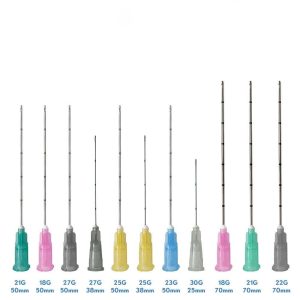
| Intradermal injections | 25G-27G | Orange/Grey | 10-16mm |
| Subcutaneous (SC) | 23G-25G | Blue/Orange | 16-25mm |
| Intramuscular (IM) | 21G-23G | Green/Blue | 25-38mm |
| Intravenous (IV) access | 18G-21G | Pink/Green | 25-40mm |
Critical Specification: Ensure needle gauge colour-coding complies with ISO 6009 (universal colour standards). Non-compliant colour schemes create clinical errors.
Graduation Mark Tolerances:
Per ISO 7886-1, graduation accuracy must be within:
- ±5% for nominal capacities up to 1ml
- ±4% for nominal capacities >1ml to 5ml
- ±3% for nominal capacities >5ml
Request Certified Measurement System Analysis (MSA) demonstrating compliance.
5.2 Packaging & Labelling: Regulatory Compliance Requirements
Individual Sterile Packaging:
Two dominant formats:
- Thermoformed Blister Packs (Peelable Lid):
- Materials: PET/PETG tray + Tyvek® or medical-grade paper lid
- Advantages: Superior sterility maintenance, tamper-evident, ease of aseptic opening
- Disadvantages: Higher cost (+$0.0015-0.003 per unit), lower container loading density
- Peel Pouches (Medical-Grade Paper/Film):
- Materials: Medical paper + polyethylene or polypropylene film
- Advantages: Cost-effective, lighter weight, easier waste disposal
- Disadvantages: More susceptible to rough handling damage
Labelling Compliance (MDR Annex I, Section 23):
Every primary package must display:
✅ Mandatory Information:
- CE mark + 4-digit Notified Body number (e.g., CE 0123)
- Manufacturer’s name and address
- UDI carrier (DataMatrix or QR code) containing Basic UDI-DI
- LOT number (batch traceability)
- Manufacturing date (month/year minimum)
- Expiry date (month/year minimum; “Use by” label)
- “STERILE” designation + sterilisation method symbol (EO symbol per ISO 15223-1)
- “SINGLE USE” symbol (ISO 15223-1: crossed-out “2”)
- Storage conditions (if temperature-sensitive)
✅ Language Requirements: EU member states mandate labelling in national languages. For pan-European distribution:
- Minimum: English + language(s) of destination country
- Optimal: English, German, French, Italian, Spanish (covers 80% of EU population)
- Alternative: Multi-language booklet inserts (more cost-effective than printing 10+ language labels)
UDI Compliance Deadline:
- Class IIa devices: UDI mandatory since 26 May 2021
- All labels must include machine-readable UDI (DataMatrix preferred; linear barcodes acceptable for outer packaging)
Outer Carton Requirements:
- Shipping carton labels must replicate primary package information
- Additional: Gross/net weight, carton dimensions, “Handle with Care” / “Fragile” symbols
- Pallet labels: SSCC-18 barcode (Serial Shipping Container Code) for logistics tracking
Negotiation Leverage: Request PDF proofs of all labelling before production. Changes post-printing incur setup fees ($800-1,500) and delay shipments by 2-4 weeks.
5.3 Payment Terms & Financial Risk Management
Standard Payment Structures for Chinese Medical Device Exports:
| Payment Term | Typical Structure | Risk Profile (Buyer) | When to Use |
|---|---|---|---|
| T/T (Telegraphic Transfer) | 30% deposit + 70% against B/L copy | Medium | First-time orders, unestablished relationships |
| L/C (Letter of Credit) | Irrevocable, confirmed L/C at sight | Low | High-value orders (>$100,000), new suppliers |
| D/P (Documents against Payment) | Payment before document release | Medium-High | Established suppliers, moderate order values |
| O/A (Open Account) | Net 30/60/90 days post-delivery | High | Long-term partnerships, audited suppliers only |
Recommended Approach for Medical Device Procurement:
First Order (Trial):
- 30% T/T deposit upon contract signing
- 70% T/T against scan of Bill of Lading + pre-shipment inspection report
- Retention: 5% held until post-delivery quality verification (released 30 days after goods receipt)
Established Relationship (3+ successful orders):
- Irrevocable Letter of Credit at 60 days sight
- Allows time for goods inspection and customs clearance before payment
- Provides supplier with bankable payment assurance
Letter of Credit Key Clauses:
✅ Documents Required:
- Commercial Invoice (3 originals, certified)
- Packing List (detailed SKU breakdown)
- Bill of Lading (full set, “clean on board”)
- Certificate of Origin (preferential tariff eligibility)
- CE Certificate (notarized copy)
- ISO 13485 Certificate (notarized copy)
- Pre-shipment Inspection Report (by SGS, Bureau Veritas, or Intertek)
- Test Reports (biocompatibility, sterilisation validation)
⚠️ Discrepancy Management: Banks charge $75-150 per L/C amendment. Ensure documentation requirements are unambiguous and achievable.
Trade Credit Insurance:
For orders exceeding €250,000, consider credit insurance from:
- Euler Hermes (Germany-based, specializes in EU-Asia trade)
- Atradius (Netherlands-based, strong medical device vertical)
- Coface (France-based, comprehensive emerging market coverage)
Premium rates: 0.3-0.8% of invoice value, depending on supplier credit rating.
5.4 Quality Acceptance Criteria: AQL Standards & Inspection Protocols
Acceptable Quality Limit (AQL) Definitions:
AQL is the maximum percentage of defects considered acceptable. Medical devices require stringent AQL levels:
ISO 2859-1 Sampling Plans for Syringes:
| Defect Classification | Definition | AQL Level | Rejection Criteria |
|---|---|---|---|
| Critical Defects | Renders product unsafe/unusable (e.g., needle detachment, broken barrel, contamination) | 0.065 | Zero tolerance—reject entire lot if any critical defect found |
| Major Defects | Reduces usability but not unsafe (e.g., graduation mark misalignment >5%, loose plunger) | 1.0 | >1% defect rate triggers lot rejection |
| Minor Defects | Cosmetic issues with no performance impact (e.g., minor scratches, slight colour variation) | 2.5 | >2.5% defect rate triggers lot rejection |
Pre-Shipment Inspection (PSI) Protocol:
Engage third-party inspection companies for independent verification:
Inspection Scope:
- Visual Inspection (sample per AQL II level, typically 315 units from 140,000-unit lot)
- Packaging integrity (blister seal quality, no punctures)
- Labelling accuracy (CE mark, lot code, expiry date verification)
- Physical damage (bent needles, cracked barrels)
- Dimensional Verification (sample size: 50 units)
- Nominal capacity accuracy (water displacement testing)
- Needle gauge verification (wire gauge measurement)
- Graduation mark spacing (caliper measurements)
- Functional Testing (sample size: 30 units)
- Plunger movement smoothness (force <20N per ISO 7886-1)
- Luer fitting leak test (pressure decay test)
- Needle penetration force (<10N for 21G)
- Dead space measurement (<0.07ml for 3ml syringe)
- Sterility Verification (destructive testing, sample size: 10 units)
- Package integrity test (dye penetration or bubble test)
- Sterility assurance level (SAL) verification (typically 10⁻⁶)
Inspection Costs:
- Basic PSI (visual + dimensional): $350-500 per man-day
- Advanced testing (including lab analysis): $800-1,200
- Rush inspection (24-48 hour report): +50% premium
Contractual Insertion: Include PSI clause requiring supplier to cover re-inspection costs if initial inspection failure rate exceeds AQL thresholds.
5.5 Logistics Insurance & Cargo Damage Prevention
Marine Cargo Insurance Coverage:
Medical devices require specialized coverage beyond standard cargo policies:
Institute Cargo Clauses (ICC) Comparison:
| Coverage Type | Included Perils | Exclusions | Premium Rate | Recommended for Medical Devices? |
|---|---|---|---|---|
| ICC (A) – All Risks | Physical loss/damage from external causes, theft, non-delivery | War, strikes, inherent vice | 0.20-0.30% | ✅ Yes (comprehensive) |
| ICC (B) – Named Perils | Fire, explosion, vessel grounding, collision | Theft, rain damage, improper stowage | 0.12-0.18% | ❌ Inadequate |
| ICC (C) – Basic | Total loss only (vessel sinking, collision total loss) | Partial damage, theft, water damage | 0.08-0.12% | ❌ Insufficient |
Additional Coverage Endorsements:
- Refrigerated Container Breakdown (if temperature-sensitive): +0.05%
- Fumigation/Contamination (protects against customs fumigation damage): +0.03%
- Delay in Start-Up (DSU) (covers business interruption from delayed delivery): +0.10-0.15%
Container Stuffing Best Practices:
Request supplier to follow IMDG Code (International Maritime Dangerous Goods) guidelines, even though syringes are non-hazardous:
✅ Weight Distribution:
- Heavier cartons at bottom, lighter on top
- Weight evenly distributed to prevent container tipping during transport
✅ Securing Methods:
- Dunnage bags (inflatable airbags) fill void spaces (prevents shifting)
- Corner protectors on pallet edges
- Anti-slip mats between pallet layers
✅ Photographic Documentation:
- Request timestamped photos of container loading process
- Seal verification photo (container door seal number must match Bill of Lading)
Chapter 6: Post-Importation Compliance—Pharmacovigilance & Market Surveillance
MDR compliance extends far beyond import clearance. European importers assume significant post-market obligations.
6.1 Post-Market Surveillance (PMS) Requirements
Article 83 MDR—Ongoing Obligations:
Importers must establish PMS systems to:
✅ Collect & Analyse Field Data:
- Adverse event reports from end-users (hospitals, clinics)
- Complaint trends (needle detachment, plunger sticking)
- Comparative performance data vs. competitor products
✅ Generate PMS Reports:
- Periodic Safety Update Reports (PSURs): Annually for Class IIa devices
- Summary of Safety & Clinical Performance (SSCP): Published in EUDAMED, updated at least every 5 years
Practical Implementation:
- Designate a Person Responsible for Regulatory Compliance (PRRC) within your organization
- Implement complaint tracking software (e.g., MasterControl, Sparta Systems, or TraceLink)
- Establish direct communication channels with hospital procurement departments to capture feedback
6.2 Incident Reporting Obligations
Serious Incidents Triggering Mandatory Reporting (Article 87):
Report to national competent authority within:
- Death or serious deterioration in health: 15 calendar days from awareness
- Other serious incidents: 30 calendar days from awareness
Examples Specific to Syringes:
- Needle detachment causing embolism or retained foreign body requiring surgery
- Contamination leading to infection
- Medication dosing error due to inaccurate graduations
- Anaphylactic reaction to residual ethylene oxide
Reporting Mechanism:
- Electronic submission via EUDAMED’s incident reporting module
- Coordinate with manufacturer’s EC Rep (joint reporting responsibility)
6.3 Traceability & Recall Readiness
UDI-Driven Traceability:
Leverage UDI system for rapid lot identification:
✅ Traceability Documentation:
- Maintain records linking UDI-DI to specific shipments/customers for minimum 10 years
- Electronic batch records (EBR) systems recommended
- Integrate with hospital pharmacy ERP systems where possible
Recall Simulation Exercises:
Conduct annual “mock recalls” to test system effectiveness:
- Trigger Scenario: Sterilisation validation failure detected for Lot XYZ123
- Response Protocol:
- Identify all affected units via UDI database search (target: <4 hours)
- Notify all customers who received affected lots (target: <8 hours)
- Issue Field Safety Notice (FSN) via EUDAMED and direct communication
- Arrange return logistics and replacement shipments
Regulatory Expectation: Ability to recall 100% of distributed products within 48 hours of decision.
Chapter 7: Emerging Trends—Safety Syringes & Sustainability Imperatives
7.1 The Safety Syringe Revolution: Regulatory Drivers & Market Shift
EU Directive 2010/32/EU (Sharps Injury Prevention):
Mandates employers in healthcare settings to:
- Eliminate unnecessary use of sharps
- Provide medical devices incorporating safety-engineered protection mechanisms
- Prohibit recapping of needles
Market Impact: Safety syringe adoption accelerating at 12-15% CAGR in EU, driven by:
- Legal compliance pressures
- Healthcare worker safety advocacy
- Insurance premium reductions for facilities with low needle-stick injury rates
Safety Mechanism Categories:
| Type | Mechanism | Activation | Cost Premium | Adoption Rate (EU) |
|---|---|---|---|---|
| Retractable Needle | Needle retracts into barrel post-injection | Automatic after full plunger depression | +180-250% | 35% |
| Sliding Sheath | Protective sleeve slides over needle | Manual (user activates guard) | +120-180% | 40% |
| Hinged Shield | Hinged safety cover locks over needle | Manual (one-handed operation) | +100-150% | 15% |
| Self-Destructive | Plunger locks permanently after use | Automatic (prevents re-use) | +80-120% | 10% |
Procurement Considerations:
- Clinical Acceptance: Engage end-users (nursing staff) in product evaluation—complex activation mechanisms face adoption resistance
- Training Requirements: Budget for supplier-provided clinical training (typically €500-800 for 2-hour sessions covering 20-30 staff)
- Compatibility: Verify compatibility with existing medication vial systems and transfer devices
7.2 Sustainability & Environmental Responsibility
Medical Plastic Waste Challenge:
Single-use medical devices contribute ~25% of hospital waste by volume in EU. Progressive healthcare systems (e.g., NHS England, German hospital networks) increasingly factor environmental impact into procurement scorecards.
Supplier Differentiation Opportunities:
✅ Lightweight Design:
- Reducing barrel wall thickness by 0.1mm cuts plastic use by ~8%
- Requires advanced mould engineering to maintain structural integrity
- Request material reduction data with comparative strength testing
✅ Recyclable/Biodegradable Packaging:
- Shift from PVC blister trays to PET/rPET (recyclable)
- Replace foam inserts with molded pulp alternatives
- Cost neutral or minor premium (+2-4%), but strong ESG appeal
✅ Carbon Footprint Transparency:
- Leading Chinese manufacturers now offer Product Carbon Footprint (PCF) declarations
- Calculated per ISO 14067 standards
- Typical 3ml syringe: 8-12g CO₂e (from raw material extraction through factory gate)
Procurement RFP Language: Include sustainability criteria weighted at 10-15% of total score:
- “Provide Product Environmental Declaration (PED) per ISO 14025”
- “Detail waste reduction initiatives across product lifecycle”
- “Confirm compliance with RoHS Directive (hazardous substance restrictions)”
Chapter 8: Procurement Decision Framework—Final Checklist & Action Plan
8.1 Pre-Purchase Verification Checklist
Print and complete this checklist before signing purchase orders:
Regulatory Compliance (Non-Negotiable)
- [ ] MDR CE Certificate verified via NANDO database (Notified Body legitimacy confirmed)
- [ ] Certificate expiry date >12 months from expected delivery date
- [ ] Product scope explicitly lists “sterile disposable syringes” on certificate
- [ ] ISO 13485:2016 certificate current (issued within 3 years, surveillance audit within 12 months)
- [ ] EC Authorised Representative identified and EUDAMED-registered
- [ ] UDI-DI assigned and searchable in EUDAMED
- [ ] Product-specific test reports available (ISO 7886 series, biocompatibility)
Supplier Capability Assessment
- [ ] Factory audit completed (own team or third-party) with photographic evidence
- [ ] Cleanroom certifications verified (ISO Class 7/8 minimum)
- [ ] Automated production lines confirmed (visit or video documentation)
- [ ] OEM/ODM references contacted and positive feedback received
- [ ] Financial stability checked (Dun & Bradstreet report or equivalent)
- [ ] Export performance verified (China Customs export data if accessible)
Commercial Terms Clarity
- [ ] Incoterm explicitly stated (FOB/CIF/etc.) with named port
- [ ] Unit pricing locked for minimum 6-month period (raw material price protection)
- [ ] Minimum Order Quantity (MOQ) acceptable and aligned with demand forecast
- [ ] Lead time defined (production + shipping, typically 45-60 days China to EU)
- [ ] Payment terms negotiated (L/C or retention holdback for quality assurance)
- [ ] AQL standards contractually specified (Critical: 0.065, Major: 1.0, Minor: 2.5)
Product Specifications Locked
- [ ] Needle gauge and length confirmed per clinical requirements
- [ ] Luer type specified (Slip vs. Lock ratio defined)
- [ ] Graduation mark accuracy validated (<±4% tolerance for 3-5ml)
- [ ] Packaging format finalized (blister vs. peel pouch)
- [ ] Labelling languages confirmed (minimum English + destination country)
- [ ] UDI barcode placement verified (readable through packaging)
Logistics & Insurance
- [ ] Ocean freight rate confirmed and validity period stated
- [ ] Marine cargo insurance obtained (ICC(A) All Risks minimum)
- [ ] Customs broker engaged in destination country
- [ ] Import duty rate verified via TARIC database (typically 6.5%)
- [ ] VAT reclaim process understood (if applicable)
- [ ] Final mile distribution plan confirmed (direct delivery or warehousing)
Risk Mitigation Measures
- [ ] Pre-shipment inspection arranged (SGS, Bureau Veritas, or Intertek)
- [ ] Inspection criteria aligned with contract AQL standards
- [ ] Sample approval completed (golden sample retained for future reference)
- [ ] Complaint handling process defined (NCR response time <7 days)
- [ ] Recall simulation plan drafted (traceability system tested)
8.2 Supplier Performance Scorecarding
Implement quarterly supplier evaluations across these weighted criteria:
| Criterion | Weight | Evaluation Metrics | Target Performance |
|---|---|---|---|
| Quality | 40% | – Defect rate (critical/major/minor)<br>- Customer complaint frequency<br>- Regulatory non-conformances | – Critical: 0%<br>- Major: <0.5%<br>- Zero regulatory issues |
| Delivery | 25% | – On-time delivery rate<br>- Lead time consistency<br>- Order accuracy | – >95% on-time<br>- ±5 days variance<br>- 100% accuracy |
| Compliance | 20% | – Certificate currency<br>- Documentation completeness<br>- Audit cooperation | – All certs >6mo valid<br>- <2% doc errors<br>- Full transparency |
| Responsiveness | 10% | – Quote turnaround time<br>- Technical query response<br>- Issue resolution speed | – <48hr quotes<br>- <24hr responses<br>- <7 day resolutions |
| Innovation | 5% | – New product development<br>- Process improvements<br>- Cost reduction initiatives | – 1+ new product/year<br>- Proactive suggestions<br>- Demonstrated savings |
Action Triggers:
- Score 90-100%: Preferred supplier status, consider volume increase
- Score 75-89%: Acceptable performance, maintain current relationship
- Score 60-74%: Corrective action plan required within 30 days
- Score <60%: Supplier development programme or phase-out initiated
8.3 Long-Term Partnership Development
From Transactional to Strategic:
Once a supplier demonstrates consistent performance over 6-12 months, consider these partnership deepening strategies:
✅ Collaborative Forecasting:
- Share 12-month rolling forecasts (binding for 3 months, indicative for 9)
- Enables supplier raw material planning and preferential capacity allocation
- Negotiate volume-based rebates (e.g., 2% rebate if annual volume exceeds forecast by >10%)
✅ Joint Product Development:
- Co-develop private label specifications tailored to regional clinical preferences
- Share market intelligence on emerging EU regulatory trends
- Supplier absorbs tooling costs in exchange for exclusive supply commitments
✅ Quality System Integration:
- Direct ERP integration (automated PO transmission, inventory visibility)
- Shared quality metrics dashboards (real-time defect rate tracking)
- Joint root cause analysis (CAPA teams include both parties’ quality engineers)
Contractual Framework for Strategic Partnerships:
- Multi-year supply agreements (2-3 years) with annual price review mechanisms
- Exclusivity clauses (supplier commits to non-compete in defined territories/channels)
- Performance guarantees (liquidated damages for quality failures, delivery delays)
- Force majeure provisions (pandemic, geopolitical disruptions—define acceptable delays and remedies)
Conclusion: Navigating Complexity for Sustainable Cost Advantage
The European disposable syringe procurement landscape demands a sophisticated balance: relentless cost optimization without compromising regulatory compliance or quality assurance. Chinese manufacturing offers undeniable economic advantages—30-50% cost savings at scale—but these savings evaporate rapidly if due diligence is insufficient.
Success Factors Distilled:
- Regulatory Vigilance: MDR compliance is not optional. Invest time verifying Notified Body certifications and EUDAMED registration before financial commitment.
- Total Cost Accounting: Look beyond FOB pricing. Factor duties, VAT, logistics, inspection costs, and potential non-conformance expenses into ROI calculations.
- Supplier Partnership Mindset: Treat capable suppliers as strategic partners, not adversaries. Transparent communication and collaborative problem-solving yield superior long-term outcomes.
- Risk-Proportionate Contracting: Match payment terms, inspection rigor, and legal protections to order value and supplier track record. Over-engineering small orders creates inefficiency; under-protecting large orders courts disaster.
- Continuous Improvement Culture: Implement structured supplier scorecards and feedback loops. The best suppliers use your input to enhance processes—passive suppliers stagnate.
The Evolving Landscape:
As EU-China trade relations mature, expect:
- Increased regulatory harmonization (China NMPA aligning with MDR principles)
- Digital supply chain tools (blockchain-based traceability, AI-powered quality prediction)
- Sustainability mandates (carbon footprint disclosure becoming standard RFP requirement by 2028)
Final Recommendation:
For procurement organizations new to China sourcing: start with smaller trial orders (1-2 containers), over-invest in verification (factory audits, third-party testing), and build institutional knowledge before scaling. For experienced buyers: continuously benchmark supplier performance against evolving best practices, and don’t hesitate to dual-source critical SKUs to mitigate concentration risk.
The path to procurement excellence lies not in finding the absolute lowest price, but in architecting resilient, compliant, cost-effective supply chains that deliver value year after year.
Appendix A: Essential Resources & Contact Information
Regulatory Authorities & Databases
EUDAMED (European Database on Medical Devices)
- URL: https://ec.europa.eu/tools/eudamed
- Function: Verify manufacturer/EC Rep registration, UDI-DI lookup, incident reports
NANDO (New Approach Notified and Designated Organisations)
- URL: https://ec.europa.eu/growth/tools-databases/nando/
- Function: Verify Notified Body accreditation and scope
National Competent Authorities (Sample):
- Germany (BfArM): https://www.bfarm.de
- France (ANSM): https://ansm.sante.fr
- Netherlands (IGJ): https://www.igj.nl
- Italy (Ministry of Health): https://www.salute.gov.it
Standards Organizations
ISO (International Organization for Standardization)
- URL: https://www.iso.org
- Purchase standards: ISO 7886 series, ISO 13485, ISO 14644
CEN (European Committee for Standardization)
- URL: https://www.cencenelec.eu
- Harmonised standards supporting MDR compliance
Third-Party Testing & Inspection Services
SGS (Société Générale de Surveillance)
- Medical device testing & inspection: https://www.sgs.com
- China offices: Shanghai, Guangzhou, Shenzhen
Bureau Veritas
- Product certification & factory audits: https://www.bureauveritas.com
- Strong presence in Jiangsu Province manufacturing hubs
Intertek
- Pre-shipment inspection & laboratory testing: https://www.intertek.com
- Medical device division with EU MDR expertise
Industry Associations
EUCOMED (MedTech Europe)
- URL: https://www.medtecheurope.org
- Industry guidance documents, regulatory updates
AESGP (Association of the European Self-Medication Industry)
- URL: https://www.aesgp.eu
- Relevant for OTC syringe products
Customs & Trade Information
EU TARIC Database (Customs Tariff)
- URL: https://ec.europa.eu/taxation_customs/dds2/taric/taric_consultation.jsp
- Search: HS Code 9018.31.10.00 for disposable syringes
World Customs Organization (WCO)
- URL: https://www.wcoomd.org
- HS Code classification guidance
Freight & Logistics Platforms
Freightos (Freight rate benchmarking)
- URL: https://www.freightos.com
- Real-time container rate comparisons China-Europe routes
Flexport (Digital freight forwarding)
- URL: https://www.flexport.com
- Visibility tools for medical device shipments
Appendix B: Glossary of Technical Terms
AQL (Acceptable Quality Limit): Statistical sampling methodology defining maximum acceptable defect rates.
Biocompatibility: Material property indicating safety for contact with human tissue, evaluated per ISO 10993 standards.
CIF (Cost, Insurance, Freight): Incoterm where seller delivers goods to destination port with freight and insurance prepaid.
Cleanroom: Controlled environment with specified particulate contamination limits, classified per ISO 14644.
EC Rep (Authorised Representative): EU-established entity assuming MDR compliance responsibilities for non-EU manufacturers.
EO (Ethylene Oxide): Gas sterilisation method commonly used for heat-sensitive medical devices.
FOB (Free On Board): Incoterm where seller’s responsibility ends when goods are loaded on vessel.
Luer Lock: Threaded syringe-needle connection providing secure attachment.
Luer Slip: Tapered friction-fit syringe-needle connection allowing quick attachment/detachment.
MDR (Medical Device Regulation): EU Regulation 2017/745 governing medical device safety and performance requirements.
Notified Body: Independent organization designated by EU member states to assess medical device conformity.
PSUR (Periodic Safety Update Report): Mandatory report summarizing medical device safety data.
SAL (Sterility Assurance Level): Probability of non-sterile unit, typically 10⁻⁶ for medical devices.
UDI (Unique Device Identifier): Barcode-based tracking system enabling device traceability throughout supply chain.
Document Version: 1.0
Publication Date: May 2026
Next Review: May 2027
This guide is intended for informational purposes. Readers should consult qualified legal and regulatory professionals for specific compliance advice.
Author’s Note: This comprehensive guide synthesizes current regulatory frameworks, industry best practices, and practical procurement experience. The medical device regulatory landscape evolves continuously—readers are encouraged to verify all regulatory citations against current official sources. For updates and supplementary resources, visit [insert company website/resource portal].
Acknowledgments: This guide benefits from input by European procurement professionals, Chinese manufacturer quality systems experts, and regulatory affairs specialists across EU competent authorities. Special thanks to contributors who provided anonymized case studies and cost data.